

The MRT is Bangkok’s metro network: the underground Blue Line through the centre and old city, plus the elevated Purple, Pink and Yellow Lines serving the suburbs. For most visitors, the easiest way to ride is to tap a contactless bank card at the gate. No ticket or top-up is needed.
Quick Facts: Bangkok MRT
- Lines: Blue, Purple, Pink (Wiwat Nakhon Line), and Yellow
- Hours: approximately 6:00 am to midnight
- Fares (distance-based): Blue Line THB 17–44 (since 3 July 2026), Purple Line THB 14–42, Pink and Yellow Lines THB 15–45
- Coming 1 January 2027: a planned THB 45 fare cap across all Bangkok rail lines, with one entry fare per journey (not yet confirmed for non-Thais)
- Easiest way to pay: contactless Visa, Mastercard or UnionPay card, accepted on all four MRT lines. Single-journey tokens are also available
- Old MRT cards: no longer accepted at the gates since 1 June 2026
- Key interchanges: Sukhumvit (BTS Asok), Si Lom (BTS Sala Daeng), Chatuchak Park (BTS Mo Chit), Tao Poon, Lat Phrao, Samrong and Wat Phra Sri Mahathat
- Map: see the full Bangkok rail transit map (MRT, BTS & Airport Rail Link)
Use the table of contents below to jump straight to fares, payment options, individual lines or station tips.
Table of Contents
What is the MRT?

The MRT is Bangkok’s Mass Rapid Transit network. It started with the mostly underground Blue Line, the city’s first metro line, and has since expanded with the elevated Purple Line and two driverless monorails: the Pink Line (officially the Wiwat Nakhon Line) and the Yellow Line.
Although some elevated MRT lines look similar to the BTS Skytrain, the two systems are run by different operators. You can tap a contactless bank card on all four MRT lines, but the BTS uses its own tickets and the Rabbit card, so plan for separate payments when you transfer between the two.
Underground Blue Line stations are fully air-conditioned and a welcome escape from the heat. Elevated stations on the Purple, Pink and Yellow Lines are covered but open-air, so they feel warmer. Trains on all lines are strongly air-conditioned and can feel cold.
Several outer stations offer Park & Ride, including Khlong Bang Phai (Purple Line), Lak Song (Blue Line), Min Buri (Pink Line) and Samrong (Yellow Line). Rates and conditions differ per facility, so check the signs on arrival.
Operating Hours
- Daily: 6:00 am – midnight
Train Frequency
- Peak hours: every 5-7 minutes
- Off-peak: every 7-10 minutes
Passenger Support
- Bilingual signage and announcements (Thai & English)
- MRT Call Center: +66 (0) 2716 4044 (8:00 am – 5:00 pm)
- Assistance available for visually impaired and disabled passengers on request
Insider Tips
- Each passenger needs their own card or token. You cannot tap one card for two people.
- On the Pink and Yellow Lines, the contactless card reader is next to the manual swing gate in front of the ticket office, not at the regular ticket gates.
- Carry coins or small banknotes if you plan to buy a single-journey token, as ticket machines take cash.
- Avoid rush hour where possible: roughly 7:30 to 9:00 am and 5:30 to 7:30 pm.
- Use Google Maps, Moovit or ViaBus to check routes, interchanges and travel times.
- On escalators, most people stand on the right and walk on the left, although not everyone follows this.
Bangkok Rail Transit Map: MRT, BTS, Airport Rail Link & More
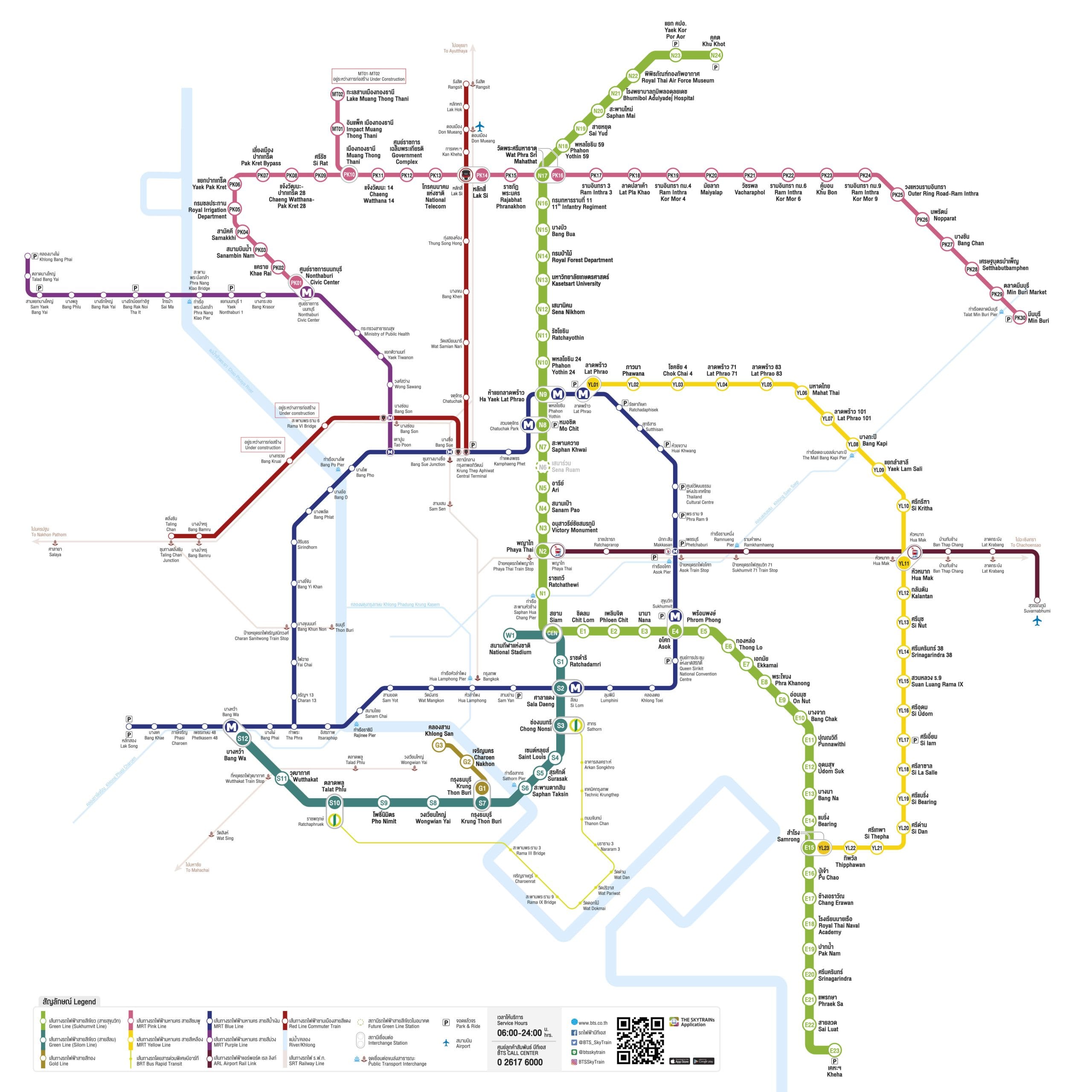
View the full Bangkok rail transit map
This map includes the MRT Blue, Purple, Pink and Yellow Lines, BTS Skytrain, Airport Rail Link, Red Line, Gold Line and SRT connections.
Tip: Open or download the full-size map before travelling so you can check routes and interchange stations on your phone.
MRT Lines
Bangkok’s MRT network consists of several distinct lines, each serving different parts of the city and surrounding suburbs, with key interchange stations connecting the system.
MRT Blue Line
(Hua Lamphong ↔ Tha Phra Loop)
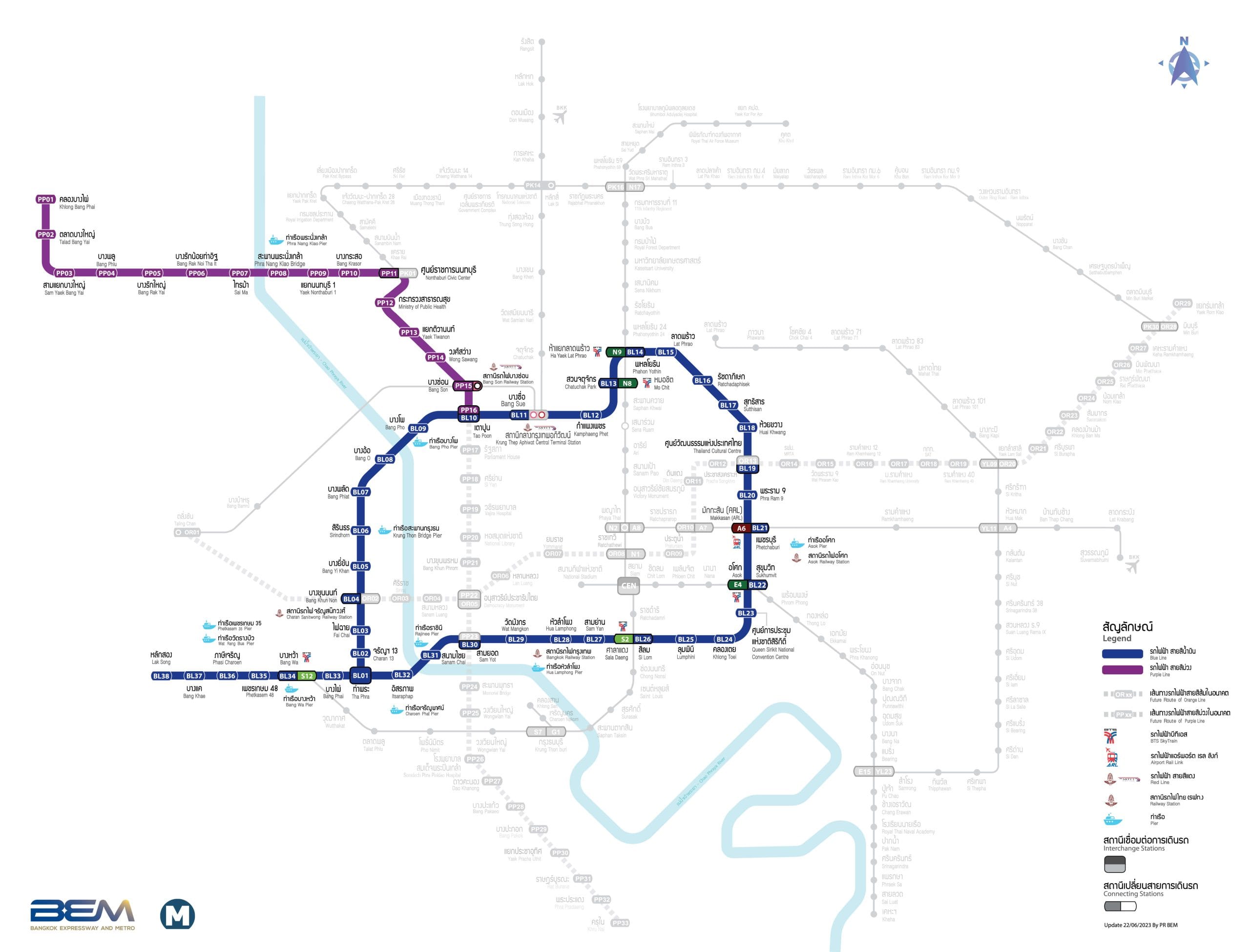
- Bangkok’s main metro line, running as a loop through the old city, Chinatown, Silom, Sukhumvit and the northern districts
- Fare: THB 17–44, depending on the number of stations (since 3 July 2026)
- Connects with the BTS at Sukhumvit (Asok), Si Lom (Sala Daeng), Chatuchak Park (Mo Chit) and Bang Wa, and with the Airport Rail Link at Phetchaburi (Makkasan)
- Interchanges with the Purple Line at Tao Poon, the Yellow Line at Lat Phrao, and the SRT Red Line at Bang Sue (Krung Thep Aphiwat), which serves Don Mueang Airport
- The stations at Sanam Chai and Wat Mangkon have striking Thai and Chinese-style interiors that are worth seeing even if you are not getting off
Key stops:
- Wat Mangkon – Closest to Chinatown (Yaowarat Road)
- Sanam Chai – For Wat Pho, Grand Palace, and riverside piers
- Chatuchak Park – Direct access to Chatuchak Weekend Market
- Sukhumvit – Connects to BTS Asok, Terminal 21, and office zones
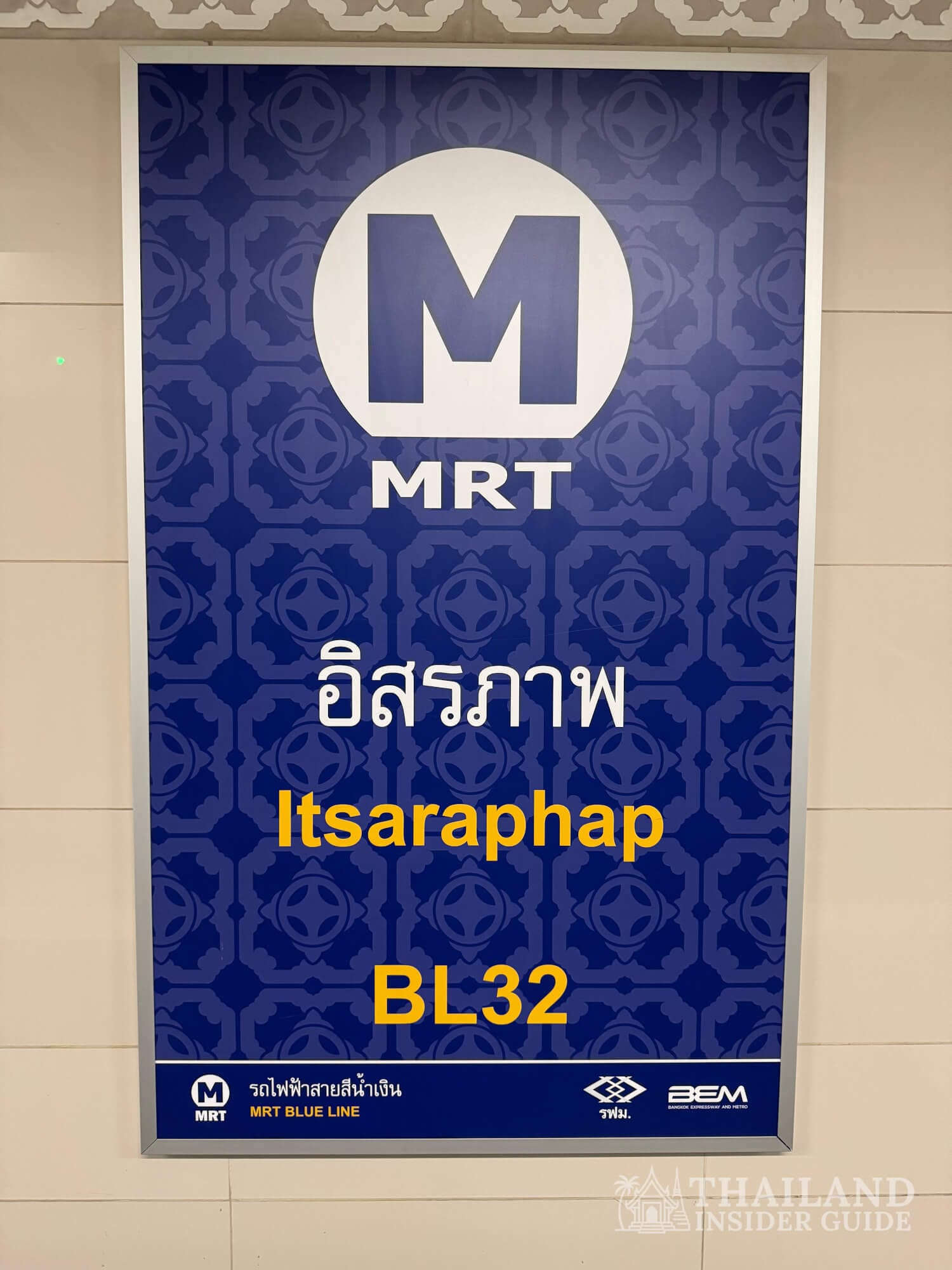
- Itsaraphap – closest to Wat Arun
MRT Purple Line
(Tao Poon ↔ Khlong Bang Phai)
The map shown in the MRT Blue Line section above also includes all stations on the MRT Purple Line, clearly showing the interchange at Tao Poon.
- Fully elevated line connecting Nonthaburi and the northwestern suburbs with central Bangkok
- Fare: THB 14–42, depending on distance
- Interchanges with the Blue Line at Tao Poon and with the Pink Line at Nonthaburi Civic Center
- Popular with commuters and residents in Nonthaburi, where housing is generally cheaper than in central Bangkok, with large Park & Ride facilities at stations such as Khlong Bang Phai
MRT Pink Line (officially named the Wiwat Nakhon Line)
(Nonthaburi Civic Center ↔ Min Buri)
- Driverless monorail, opened to public service in late 2023 and officially named the Wiwat Nakhon Line on 8 January 2026
- Fare: THB 15–45, depending on distance
- Interchanges with the Purple Line at Nonthaburi Civic Center, the SRT Red Line at Lak Si, and the BTS Sukhumvit Line at Wat Phra Sri Mahathat
- Useful stations include Government Complex and Min Buri, which has a low-cost Park & Ride with direct station access
- The ride can feel slightly bumpy, especially on curves
MRT Yellow Line
(Lat Phrao ↔ Samrong)
- Elevated, driverless monorail connecting eastern and southeastern Bangkok, with a route that is especially useful for local shopping trips, residential districts, and cross-city connections
- Fare: THB 15–45 for adults and students, THB 8–23 for seniors
- Interchanges with the MRT Blue Line at Lat Phrao and the BTS Sukhumvit Line at Samrong, making it a practical link between outer districts and the wider Bangkok rail network
- Passes several major shopping centres along Srinagarindra Road, including Seacon Square, Paradise Park, and Thanya Park
- Transfer to the Airport Rail Link at Hua Mak. The stations are not directly connected: the transfer involves a short walk at street level, which we explain step by step in our Airport Rail Link guide
- The ticket machines at the stations allow passengers to buy tickets for the Yellow Line and also destinations on the Green and Pink Lines. Machines accept coins and banknotes, and stored-value cards can also be topped up
Tickets, Fares and Cards (2026)
MRT fares are distance-based and differ per line:
- Blue Line: THB 17–44 (since 3 July 2026)
- Purple Line: THB 14–42
- Pink and Yellow Lines: THB 15–45
When you transfer between lines run by different operators, such as MRT to BTS, you currently pay a new entry fare for each system.
Discounted fares for seniors, students and passengers with disabilities are only available at ticket offices, where staff can check eligibility. On the Blue Line, children up to 120 cm tall travel free.
Accepted payment methods
- Contactless bank cards: Visa, Mastercard and UnionPay credit cards from Thai and international banks, international debit cards, and debit cards from several Thai banks. Accepted on all four MRT lines.
- Single-journey tokens: available from ticket machines (cash only) and ticket offices.
- Rabbit card: accepted on the Pink and Yellow Lines, and on the BTS. Not accepted on the Blue and Purple Lines.
- Mangmoom card: valid on all four MRT lines, but only available to Thai citizens with a Thai ID card. It does not work on the BTS or the Airport Rail Link.
When you pay by contactless card, a THB 1 charge may appear first. The actual fare is usually charged later.
Old MRT cards no longer accepted
Since 1 June 2026, the MRT has switched fully to contactless payment, and the old MRT and MRT Plus stored-value cards no longer work at the gates. If you still have one with a balance, ask at a Blue or Purple Line ticket office whether a refund is still possible.
Planned for 1 January 2027: THB 45 fare cap
The Thai government plans to introduce a common fare across Bangkok’s electric rail lines from 1 January 2027. Under the plan, you pay the entry fare only once per journey, even when transferring between operators, and the total is capped at THB 45. Fares are first charged at the normal rate, and anything above THB 45 is refunded within three working days to the Pao Tang app or the card used for the trip.
Whether this applies to foreign residents and visitors has not yet been confirmed. Early reports describe the refund as applying to Thai citizens, and earlier fare subsidies, including the THB 20 flat fare, were limited to Thai nationals. Until the final rules are published, non-Thai passengers should expect to pay standard fares on each line. We will update this section as soon as the rules are confirmed.
Bangkok Transit Cards Recap
| System | Coverage | How to pay |
|---|---|---|
| MRT Blue & Purple Lines | Underground and suburban | Contactless bank card or token |
| MRT Pink & Yellow Lines | Suburban monorails | Contactless bank card, Rabbit card or token |
| All MRT lines | Blue, Purple, Pink, Yellow | Mangmoom card (Thai ID holders only) |
| BTS Skytrain | Elevated city rail | Rabbit card or single-journey ticket |
| Airport Rail Link | Airport to city | Contactless bank card, token or Airport Rail Link card |
Insider Tip
Without a Thai ID card, a contactless Visa or Mastercard is the simplest way to ride every MRT line. You skip the ticket machine queue, and there is no card to top up.
Using the MRT: Step-by-Step
- Find your station using Google Maps, Moovit or the Bangkok rail map.
- Pass through the security check at the station entrance. Staff may ask to scan or look inside your bag.
- Decide how to pay: tap a contactless bank card, buy a single-journey token from a ticket machine or the ticket office, or use a Rabbit card on the Pink and Yellow Lines.
- Tap in at the gate:
- Blue and Purple Lines: tap contactless bank cards on the top reader, and tokens on the bottom reader. Some gates are for contactless cards only, while others accept both.
- Pink and Yellow Lines: tap contactless bank cards on the reader next to the manual swing gate in front of the ticket office. Tokens and Rabbit cards work at the regular gates.
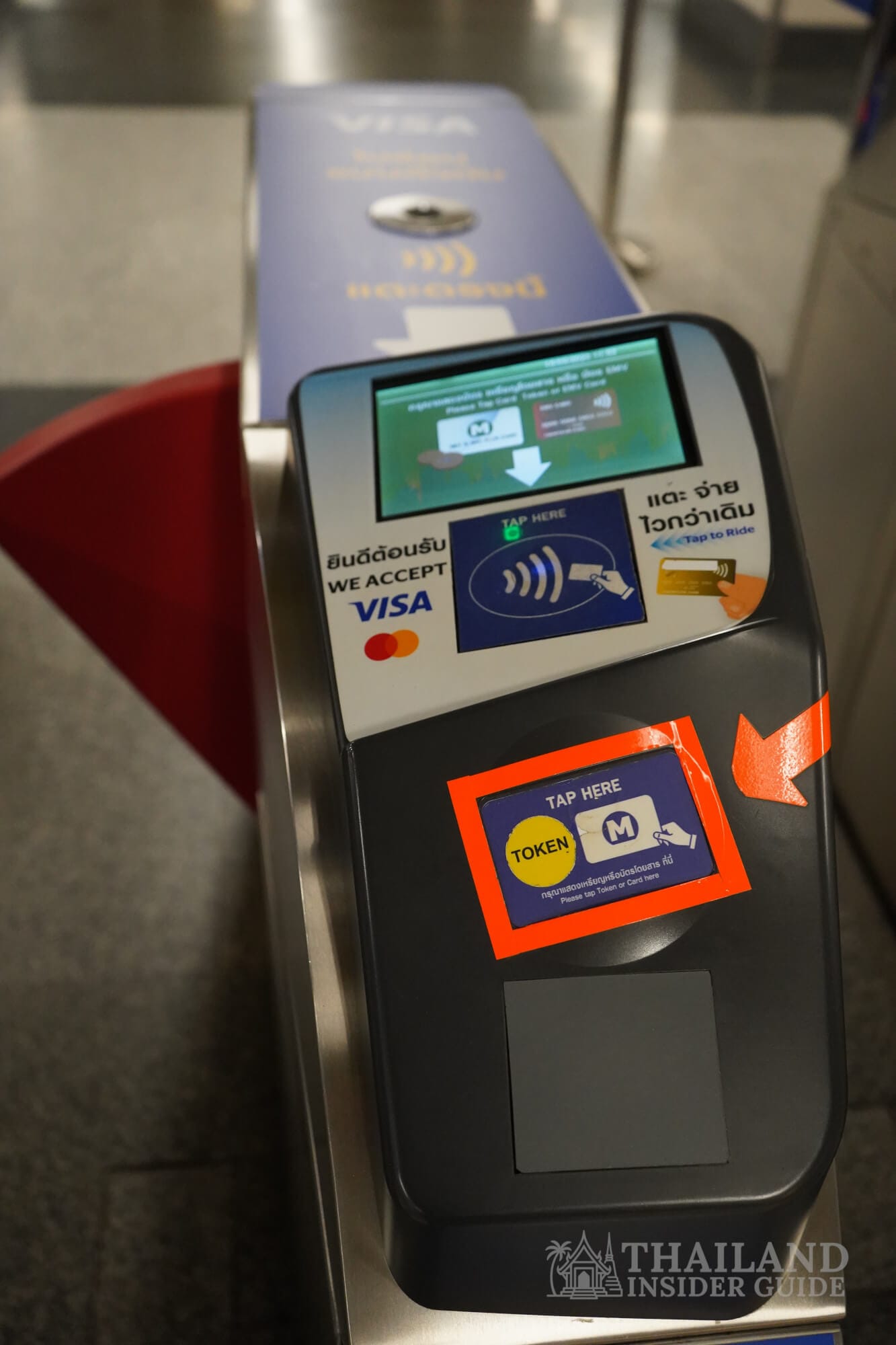
- Follow the signs to your platform and check the direction by looking at the final station of the line.
- Wait behind the floor markings, which leave space in front of the doors for passengers getting off. Let people exit before you board.
- The seats nearest the doors are usually reserved for monks, elderly passengers, pregnant women and people with disabilities.
- At your destination, tap out with the same card you used to enter. If you have a token, insert it into the slot at the exit gate.
Why Thai passengers sometimes offer seats to children
If you’re traveling on Bangkok’s MRT or BTS for the first time, you might witness a small but curious scene: a local passenger quickly jumping up to offer their seat, not to an elderly person or pregnant woman, but to a perfectly energetic young child. Foreigners often watch in bemusement, as this goes against their expectations.
Yet in Thailand, it’s common and entirely natural: children are highly cherished, and locals often feel a sense of responsibility and kindness towards them, prioritizing their comfort. It’s one of those small, heartwarming cultural details that often catches visitors by surprise and leaves a lasting impression of everyday kindness in Thailand.
Top Places Accessible via MRT
| Destination | MRT Station | Notes |
| Chatuchak Market | Chatuchak Park | Massive weekend market |
| Wat Pho & Grand Palace | Sanam Chai | Short walk to major temples |
| Wat Arun | Itsaraphap | Nearby ferry access |
| Chinatown | Wat Mangkon | Closest station to Yaowarat Road |
| Asok / Terminal 21 | Sukhumvit | Transfer to BTS Asok, access to malls and nightlife |
| Lumphini Park | Lumphini or Si Lom | Skywalk to Benjakitti Park |
| Government Complex | Government Complex (Pink Line) | Immigration and administrative offices |
| Krung Thep Aphiwat Central Terminal Station and Don Meuang Airport | Bang Sue (Blue Line) | Thailand’s main rail hub; transfer to the SRT Red Line for Don Mueang |
| Suan Luang Rama IX | Suan Luang Rama IX (Yellow Line) | Bangkok’s largest public park. Watch our sunrise walk |
Connecting Transportation Modes
- BTS Skytrain: interchanges at Chatuchak Park (Mo Chit), Sukhumvit (Asok), Si Lom (Sala Daeng) and Bang Wa on the Blue Line, Wat Phra Sri Mahathat on the Pink Line, and Samrong on the Yellow Line
- Airport Rail Link (ARL): via a covered walkway between Phetchaburi and Makkasan, or via a street-level walk between the Yellow Line and Airport Rail Link stations at Hua Mak
- SRT Red Line: at Bang Sue (Krung Thep Aphiwat) on the Blue Line and Lak Si on the Pink Line, for Don Mueang Airport and northern Bangkok
- River boats: from piers near Sanam Chai and Itsaraphap
- Public buses: serve most MRT stations and nearby junctions
- Taxis and Ride-Hailing: available at most exits
Min Buri Park & Ride
At Min Buri Station on the Pink Line, a three-floor Park & Ride building connects directly to the station. It is often quiet and poorly signposted from the street, so it is easy to miss. Parking costs THB 5 per hour for MRT passengers. To reach the train, go to the third floor, cross the sky bridge to the station, and take the stairs or lift down to the entrance. You pay for parking at a machine that accepts cash, QR code payment and the Rabbit card.
Best Time to Ride the MRT
By season
- Cool season (Nov–Feb): Ideal for sightseeing
- Rainy season (May–Oct): MRT helps you avoid flooded streets
- Hot season (Mar–May): Cool refuge from the city heat
By time of day
- Avoid rush hours: roughly 7:30 to 9:00 am and 5:30 to 7:30 pm.
- Best for comfort: Mid-morning (09:30-11:30 am) or mid-afternoon (1:30-4:00 pm).
- Late evening: Less crowded, but check last train times.
Frequently Asked Questions About the Bangkok MRT
How much does the MRT cost in Bangkok?
Fares depend on distance and line. The Blue Line costs THB 17–44, the Purple Line THB 14–42, and the Pink and Yellow Lines THB 15–45 per trip.
Can I use my Visa or Mastercard on the Bangkok MRT?
Yes. Contactless Visa, Mastercard and UnionPay cards work on all four MRT lines: Blue, Purple, Pink and Yellow. Tap the same card to enter and exit.
Can I use a Rabbit card on the MRT?
Only on the Pink and Yellow Lines. The Rabbit card is not accepted on the Blue and Purple Lines, where you need a contactless bank card or a single-journey token.
Can foreigners get a Mangmoom card?
Not at the moment. The Mangmoom card is only available to Thai citizens with a Thai ID card. Foreign residents and visitors can use a contactless bank card instead.
Does the MRT go to the airport?
Not directly. For Suvarnabhumi Airport, take the Blue Line to Phetchaburi and walk to Makkasan station for the Airport Rail Link. For Don Mueang Airport, take the Blue Line to Bang Sue and transfer to the SRT Red Line.
What are the MRT operating hours?
Trains run from approximately 6:00 am to midnight, with trains every 5 to 10 minutes depending on the time of day.
Is the MRT the same as the BTS Skytrain?
No. They are separate systems with different operators and payment options. You tap a contactless bank card on the MRT, while the BTS uses its own tickets and the Rabbit card.
Will Bangkok train fares be capped at THB 45 in 2027?
The Thai government plans a common fare capped at THB 45 per journey across all Bangkok rail lines from 1 January 2027. Whether it applies to non-Thai passengers has not yet been confirmed.
Did this guide answer your question?
If something was missing or unclear, please tell us so we can improve this guide.
Glad it helped! Thank you for letting us know.
We’d love to know what was missing.
Final Tips for Using the Bangkok MRT
The MRT is one of the most reliable ways to get around Bangkok: air-conditioned, affordable and unaffected by traffic. For most visitors, a contactless Visa or Mastercard is all you need to ride every MRT line.
Fares and payment rules are changing, with a planned THB 45 fare cap from January 2027. We will update this guide as soon as the details, including eligibility for non-Thai passengers, are confirmed.
📍 Tip: Bookmark or download the full Bangkok Train System Map (BTS, MRT, ARL) before you travel so you can check routes on the move.
🚆 Combining train systems? See our guides to Getting Around Bangkok, the BTS Skytrain Bangkok Guide and the Airport Rail Link Bangkok Guide for transfers, routes and payment tips.
Enjoyed this guide?
If Thailand Insider Guide helped you plan your trip, you can support our independent work by buying us a coffee.


