

The fastest way to get around Bangkok is usually by rail. The BTS Skytrain and MRT metro cover the central districts, run every few minutes and are never stuck in traffic. For the final stretch, walk or take a motorbike taxi or Grab. Use river boats for the Old Town and riverside sights, and switch to a taxi or ride-hailing late at night, after the trains stop, or when you have luggage.
This guide explains which option to use when, how the different lines connect, how to pay, and the mistakes that cost visitors the most time. For station-by-station details, see our guides to the BTS Skytrain, MRT and Airport Rail Link.
Use the table of contents below to jump straight to the part you need.
Table of Contents
- Which Transport Should You Use in Bangkok?
- How Bangkok's Transport Network Fits Together
- Bangkok Rail Transit Map: Airport Rail Link, BTS, MRT, & More
- Paying for Transport in Bangkok (2026)
- BTS Skytrain: When and Why to Use It
- MRT Metro: How It Complements the BTS
- Airport Connections: Getting In and Out of Bangkok
- River and Canal Boats: An Underrated Way to Get Around
- Taxis, Grab & Ride-Hailing: Flexible but Traffic-Dependent
- Buses & Other Local Transport: Cheap but Less Visitor-Friendly
- Practical Tips & Common Mistakes When Getting Around Bangkok
- How to Combine Transport for a Smooth Trip in Bangkok
- Frequently Asked Questions About Getting Around Bangkok
- Explore Further
Which Transport Should You Use in Bangkok?
No single option is best for every trip. The right choice depends on the time of day, the distance, the traffic and where you’re going.
Quick Transport Comparison
| Situation | Best Option | Why |
| Crossing the city, especially at rush hour | BTS Skytrain or MRT | Predictable travel times, no traffic |
| Short trips outside rush hour | Taxi or Grab | Door to door and usually inexpensive |
| Suvarnabhumi Airport to the city | Airport Rail Link or taxi | The train avoids traffic; a taxi is easier with luggage |
| Don Mueang Airport to the city | SRT Red Line or taxi | Same trade-off as at Suvarnabhumi |
| Grand Palace, Wat Arun, riverside hotels | Chao Phraya Express boats | Often faster than the roads, and scenic |
| Chinatown or Chatuchak | MRT plus a short walk | Stations are close to both |
| After midnight | Taxi or Grab | Most trains stop running around midnight |
| The last few hundred meters | Walking or motorbike taxi | Faster than a car on busy roads |
| A short ride for the experience | Tuk-tuk | Fun, but rarely the cheapest or fastest |
How Bangkok’s Transport Network Fits Together

Bangkok doesn’t have one central transport system. Several separate rail networks are linked at interchange stations, and river boats and road transport fill the gaps.
The lines visitors use most:
- BTS Skytrain: the Sukhumvit Line (green) and Silom Line (dark green), elevated through the main shopping and business districts.
- MRT Blue Line: an underground loop through Sukhumvit, Silom, Chinatown, the Old Town edge and Chatuchak.
- Airport Rail Link: Suvarnabhumi Airport to Phaya Thai in central Bangkok.
- SRT Red Line: from Krung Thep Aphiwat Central Terminal north to Don Mueang Airport.
Newer lines such as the MRT Purple, Yellow and Pink Lines and the short Gold Line mainly serve residential areas and outer districts. You’re most likely to use them if you’re staying outside the centre.
The key interchanges for visitors are Siam (between the two BTS lines), Asok/Sukhumvit and Sala Daeng/Si Lom (BTS and MRT), Phaya Thai (BTS and Airport Rail Link) and Makkasan/Phetchaburi (Airport Rail Link and MRT). Each network is run separately, so changing lines means leaving one system and paying again on the next, as explained in the payment section below.
Bangkok Rail Transit Map: Airport Rail Link, BTS, MRT, & More
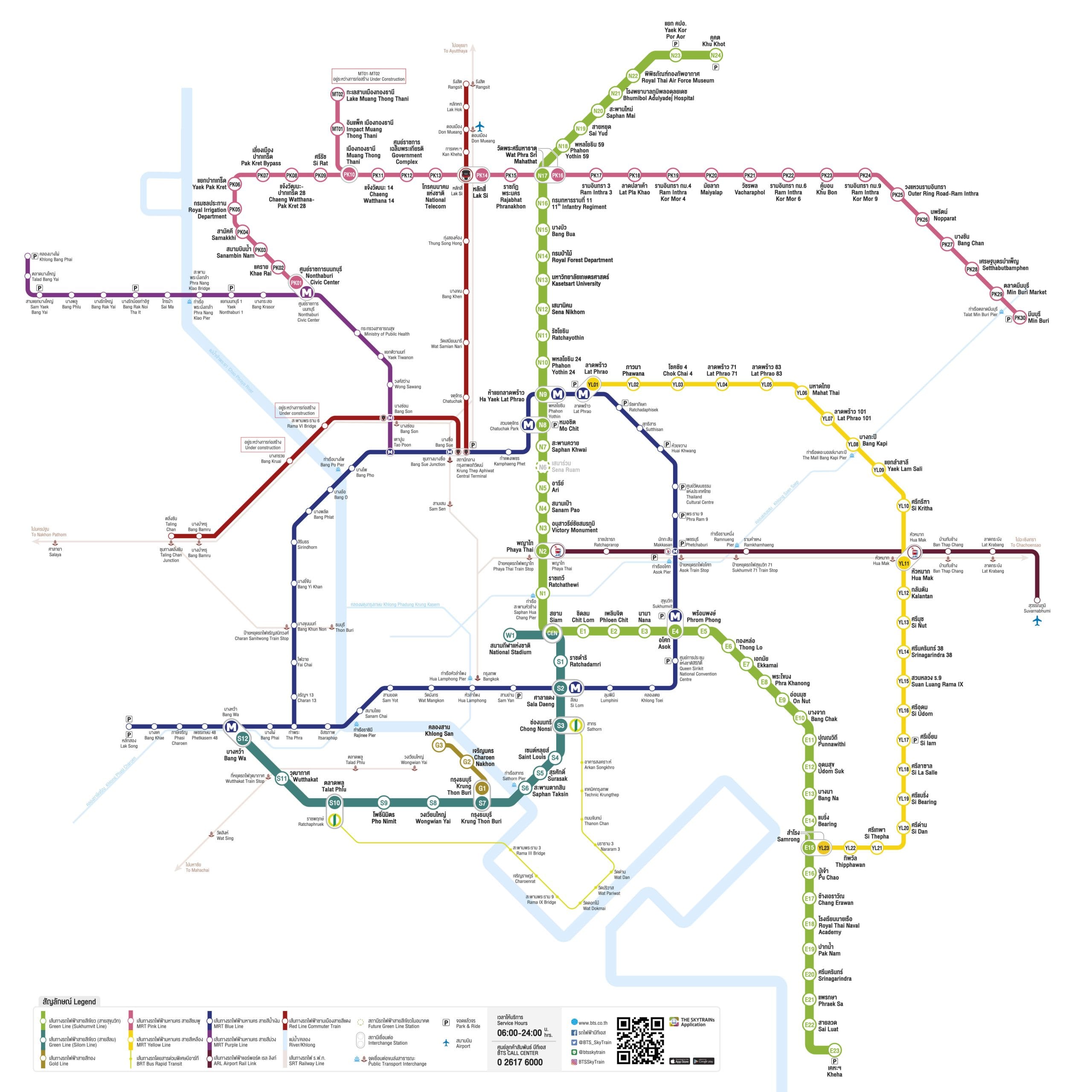
View the full Bangkok rail transit map
Shows every Bangkok rail line: BTS, MRT Blue, Purple, Yellow and Pink, Airport Rail Link, SRT Red Lines and Gold Line, with all interchange stations.
Tip: save the map to your phone before you land, so you can check routes even before your SIM card or eSIM is working.
Paying for Transport in Bangkok (2026)
Every Bangkok rail network has its own ticketing, so one card doesn’t cover everything. The good news is that a contactless bank card now works on most lines, so for many visitors one card plus some small cash covers almost every trip. The BTS is the main exception: use a Rabbit card or buy single tickets.
| Transport | Contactless bank card | Other ways to pay |
|---|---|---|
| BTS Skytrain | No | Rabbit card, single-journey ticket from machines or ticket office |
| MRT (Blue, Purple, Yellow, Pink) | Yes, on all four lines | Single-journey tokens (machines take cash only). Rabbit card on the Pink and Yellow Lines only |
| Airport Rail Link | Yes (Visa, Mastercard, JCB, UnionPay) | Single-journey tokens, ARL stored-value card. No Rabbit card |
| SRT Red Line | Yes (Visa, Mastercard) | Tickets from machines or the ticket office |
| River boats | No | Cash, at the pier or on board (canal boats: on board) |
| Metered taxis | Rarely | Cash. Thai QR payment in some taxis |
| Grab / ride-hailing | Yes, in the app | Cash, if selected in the app |
| Motorbike taxis, tuk-tuks | No | Cash |
What Works Best for Visitors
Carry one contactless Visa or Mastercard for the MRT, the Airport Rail Link and the Red Line, use a Rabbit card or single tickets for the BTS, and keep small notes (THB 20 and 100) for taxis, boats and motorbike taxis.
A few things to know about contactless cards:
- Tap in and out with the same card. A card in your phone’s wallet and the physical card count as two different cards.
- A THB 1 charge may appear first. The actual fare is usually charged later.
- Tickets don’t carry over. When you change between BTS, MRT and Airport Rail Link, you pay separately on each system.
Fare changes planned for 2027: the Thai government plans a common THB 45 fare cap across Bangkok’s rail lines from 1 January 2027. It’s not yet confirmed whether this will apply to foreign visitors and residents, so for now expect to pay standard fares on each line. See our MRT guide for the details.
Insider Tip
Before you fly, check that your bank allows contactless payments abroad and that your card shows the contactless symbol. If a gate rejects your card, it’s usually the bank blocking the foreign transaction rather than the gate. Having a second card, or a few coins for a token, saves you a trip to the ticket office.
BTS Skytrain: When and Why to Use It
The BTS Skytrain is the easiest way to get around central Bangkok. Its two elevated lines run above the traffic through Sukhumvit, Siam and Silom, where most visitors stay, shop and work, and many stations connect directly to malls and office buildings.
The BTS is less useful for the Old Town, Chinatown and most riverside sights. For those, use the MRT, a river boat, or a combination of both.
When the BTS Is the Best Choice
- Your hotel or destination is along Sukhumvit Road, around Siam, or in Silom
- You’re travelling during rush hour or on a rainy afternoon
- You’re heading to the big malls around Siam, Chit Lom and Asok
When Another Option May Be Better
- Visiting the Grand Palace, Wat Pho or Chinatown: use the MRT or a river boat
- Short door-to-door trips outside rush hour: a taxi or Grab is often easier
- Late at night: trains stop running around midnight
Insider Tip
Between BTS Siam and Chit Lom you don’t need the train at all. The covered Ratchaprasong Skywalk runs under the tracks and connects the malls along the way, so you can walk the whole stretch without crossing a road. Near Chit Lom, two sights are worth a pause:
- The circular glass Apple store next to CentralWorld, as well as the busy Ratchaprasong intersection. It’s a striking sight.
- The Erawan Shrine on the opposite corner, usually busy with worshippers, flower offerings and traditional dancers.
For routes, stations, fares and transfers, see our full BTS Skytrain guide.
MRT Metro: How It Complements the BTS
The MRT fills the gaps in the BTS network. Its Blue Line is the most useful line for visitors. It runs underground through Sukhumvit and Silom, then continues to Chinatown and the edge of the Old Town, before looping north to Chatuchak. The elevated Purple, Yellow and Pink Lines mainly serve residential districts outside the centre.
The BTS and MRT connect at several stations, including Asok/Sukhumvit, Sala Daeng/Si Lom and Mo Chit/Chatuchak Park, so you can cross most of the city by rail without using the roads.
When the MRT Is the Better Choice
- Chinatown (Wat Mangkon station) and the Old Town around Wat Pho (Sanam Chai station)
- Chatuchak Weekend Market (Chatuchak Park or Kamphaeng Phet station)
- Hua Lamphong, Khlong Toei Market and Queen Sirikit National Convention Centre
- Paying by contactless bank card on every line, without buying a separate travel card
When the BTS May Be More Convenient
- Shopping around Siam and Chit Lom
- Hotels along Sukhumvit beyond Asok, or along the Silom Line towards the river
Insider Tip
For Wat Pho and the Grand Palace, take the MRT Blue Line to Sanam Chai rather than a taxi or tuk-tuk. Exit 1 is a short walk from Wat Pho, and the station itself, designed to look like an old Thai palace hall, is worth a look on the way.
For line maps, stations, fares and transfers, see our full MRT guide.
Airport Connections: Getting In and Out of Bangkok
Bangkok has two airports. Suvarnabhumi (BKK) handles most international flights. Don Mueang (DMK) serves mainly low-cost and domestic airlines. Both have a rail link to the city, and at both the train is usually the better choice during rush hour, while a taxi or Grab is easier late at night or with a lot of luggage.
Suvarnabhumi Airport (BKK)
Airport Rail Link (Fast and Predictable)
The Airport Rail Link runs from Level B of the terminal to Phaya Thai in about 26 to 30 minutes, for THB 45. All trains stop at every station, with transfers to the MRT Blue Line at Makkasan and the BTS at Phaya Thai. You can pay with a contactless bank card.
Taxis from Suvarnabhumi Airport
Public taxis leave from Level 1, from the official queue with ticket machines. Expect to pay about THB 400 to 575 to central Bangkok, including the THB 50 airport surcharge and expressway tolls. A Grab or LINE MAN taxi costs the meter fare plus a booking fee, and private cars booked in the app have a fixed price shown upfront.
Choosing the Best Option from Suvarnabhumi
- Weekday rush hour: Airport Rail Link
- Arriving late at night or flying before about 8:00 am: taxi or Grab
- Lots of luggage, or travelling as a group of three or more: taxi
- Staying near a BTS or MRT station: Airport Rail Link plus one transfer
For arrival steps, terminal layout and SIM cards, see our Suvarnabhumi Airport guide. For stations, fares and transfers, see the Airport Rail Link guide.
Don Mueang International Airport (DMK)
Train: SRT Red Line (Fast and Predictable)
The SRT Red Line connects Don Mueang Airport with Krung Thep Aphiwat Central Terminal (formerly Bang Sue Grand Station), where you can transfer to the MRT Blue Line for Chatuchak, Sukhumvit, Silom and Chinatown.
From either terminal, follow the overhead signs for the SRT Red Line (Don Mueang Station). A covered, air-conditioned skywalk runs from the terminal through the car park area straight to the station.
- Hours: daily from 05:00 to midnight
- Frequency: about every 10 minutes at weekday peak times, every 15 minutes otherwise
- Payment: contactless Visa or Mastercard at the gates, or a ticket from the machines or ticket office
Insider Tip
On the way to the Red Line station you pass Magic Food Park, one of the cheapest places to eat at the airport. It’s popular with airport staff and serves simple Thai dishes at local prices, so it’s a good stop if you have time before your train.
Taxis and Ride-Hailing (Flexible, but Traffic-Dependent)
Follow the signs to the official taxi queue and take a number from the machine. The meter fare is charged plus a THB 50 airport surcharge and any expressway tolls. Queues can be long when several flights land at once but usually move steadily. Grab is also available, though finding the pickup point can take a while at busy times.
Choosing the Best Option at Don Meuang
- Weekday rush hour: SRT Red Line, then MRT
- Late at night or early morning: taxi, Grab or LINE MAN
- Heavy luggage: taxi
- Staying near the MRT Blue Line: Red Line plus one transfer at Krung Thep Aphiwat
River and Canal Boats: An Underrated Way to Get Around
For the Grand Palace, Wat Pho, Wat Arun and riverside hotels, a boat on the Chao Phraya River is often faster than the road, and the ride itself is part of the experience.
The most useful service for visitors is the Chao Phraya Express Boat, which stops at piers along both banks. Boats fly coloured flags to show the route and which piers they stop at, so check the flag before you board. Tickets are cheap and paid in cash, either at the pier or on board.
Services run mainly during the day and finish in the early evening, so plan your return trip before dark or switch to a taxi or the MRT.
Insider Tip
The easiest way to reach the river is by BTS to Saphan Taksin. Sathorn Pier is right below the station, and from there Chao Phraya Express Boats head north towards the Old Town, while several riverside hotels run free shuttle boats from the same pier.
Canal Boats (Khlong Boats)
The Khlong Saen Saep canal boat runs east–west through central Bangkok and is one of the fastest ways to beat rush-hour traffic. It has two lines that meet at Pratunam Pier: the Golden Mount Line heads west to the Old Town, and the NIDA Line heads east. You change boats at Pratunam if you’re travelling across both.
Fares are THB 10 to 20 depending on distance, paid in cash to the conductor on board. Boats run from early morning until about 8 pm on weekdays, with shorter hours at weekends. Boarding is quick and the piers are basic, so it suits travellers who are comfortable getting around Bangkok.
Useful connections: Asok Pier for the MRT Blue Line at Phetchaburi (and the Airport Rail Link at Makkasan), Hua Chang Pier for the BTS, and Bang Kapi Pier for the MRT Yellow Line.
Insider Tip
The canal boat also connects with the Airport Rail Link at Ramkhamhaeng, giving you a cheap route between the airport and the Old Town that avoids road traffic entirely. See our Airport Rail Link guide for details.
When Boats Make Sense
- Visiting riverside temples and landmarks
- Travelling during heavy road congestion
- Looking for a scenic alternative to trains and taxis
When Another Option Is Better
- In the evening, once services wind down
- Travelling far from the river
- Carrying large luggage
Taxis, Grab & Ride-Hailing: Flexible but Traffic-Dependent
Taxis and ride-hailing are the most flexible way to get around Bangkok: door to door, available at any hour and inexpensive by Western standards. The catch is traffic. The same trip can take 15 minutes or an hour, depending on the time of day and the weather.
Ride-Hailing Apps
Ride-hailing apps are the easiest option for most visitors. You see the price before you book, the destination is already in the driver’s app, and you can pay by card.
- Grab: the most widely used app, with the best coverage
- LINE MAN: very popular with locals; best known for food delivery, but it also offers rides
In Grab and LINE MAN you can usually book a regular metered taxi as well as a private car. A taxi booked this way costs the meter fare plus a booking fee. A private car has a fixed price shown upfront.
Download links and tips for each app are in our Best Apps for Thailand guide.
Metered Taxis
Metered taxis are everywhere and come in many colours. The colour makes no difference to the price or service.
Hailing a taxi
A taxi is free when the light in the front windscreen is switched on. Get in, then tell the driver where you’re going. If the driver refuses the trip, which is common at rush hour, simply get out and try the next one. Hotels, condos and residential estates (moo ban) can also call a taxi for you.
Using the meter
The meter starts at THB 35 (THB 40 in larger SUV taxis). If a driver won’t turn it on and quotes a fixed price instead, politely decline and take another taxi. This happens most near major attractions, nightlife areas, late at night and in heavy rain. Expressway tolls aren’t included in the meter fare and are paid by the passenger, either at the toll booth or at the end of the trip.
Pay in cash, ideally with small notes. Some taxis display a QR code for payment by Thai banking app, but foreign cards are rarely accepted.
Motorbike Taxis
Motorbike taxis wait at stands near BTS and MRT stations, at busy intersections and at the start of side streets (sois). The drivers wear numbered orange vests, and many stands have a board with fixed prices to nearby destinations, usually in Thai only.
Over short distances they’re often the fastest option, since they weave through traffic that leaves cars standing still. Tell the driver where you’re going, agree the price if there’s no board, and hold the rear grab handle during the ride. Payment is usually in cash. Helmets are offered more often than in the past, but not always.
Motorbike taxis are best for the last stretch from a station to your hotel, and not ideal with luggage or if you’re uncomfortable on a motorbike.
Tuk-Tuks: What to Know
Tuk-tuks are fun for a short ride, but they’re rarely the cheapest or fastest option. There’s no meter, so agree the price before you get in, and expect to sit in traffic and exhaust fumes on busy roads. Treat a tuk-tuk ride as part of the experience rather than as transport.
Insider Tip
Be wary of a tuk-tuk driver who offers a very cheap city tour or tells you a temple is closed today. It’s usually the start of a detour to a gem shop or tailor that pays the driver commission. Read more in our guide to scams in Thailand.
Buses & Other Local Transport: Cheap but Less Visitor-Friendly
Bangkok’s public buses reach almost every part of the city and are very cheap, but they’re the hardest option for visitors. Routes are complicated, stops are often unmarked, signs are mostly in Thai, and buses get stuck in the same traffic as cars.
If you do want to try them, the ViaBus app shows routes and the live positions of buses. Fares are paid in cash on board. See our Best Apps for Thailand guide for download links.
When Buses Can Make Sense
- You’re on a tight budget and not in a hurry
- You’re staying longer and have time to learn a few routes
- Your destination isn’t near a BTS or MRT station
When to Avoid Buses
- Short visits with a tight schedule
- Rush hour
- When you don’t know the city yet
Other Local Transport
In some neighbourhoods you’ll see songthaews, pickup trucks with two benches in the back that run fixed local routes. They’re mostly used by locals and are rarely useful in central Bangkok.
Practical Tips & Common Mistakes When Getting Around Bangkok
Most frustrations with Bangkok transport come from a handful of misunderstandings. Keep these in mind and you’ll save time, money and energy.
Don’t Underestimate Rush Hour
On weekdays, roughly 7:00 to 9:00 and 16:00 to 20:00, the roads are at their worst and trains are at their busiest. Friday evenings are usually the worst of the week. During these hours a train is almost always faster than a taxi, even when the map makes the taxi look tempting. If you must travel by road, add plenty of extra time.
Rain Changes Everything
Even a short downpour can bring Bangkok’s traffic to a standstill. Road journeys take much longer than predicted, taxis and Grab cars become hard to find, and stations get busier. If rain falls during rush hour, the BTS and MRT are the most reliable ways to get anywhere.
Insider Tip
In the rainy season, roughly May to October, afternoon storms are common. Plan longer journeys for the morning, and if you’re heading out in the afternoon, stay within walking distance of a BTS or MRT station. Many stations connect directly to malls, so you can wait out a downpour indoors.
Trains Beat Taxis More Often Than You Think
Many visitors default to taxis for convenience. Experienced Bangkok residents do the opposite: they take the BTS or MRT first and only use a taxi when the train doesn’t go near their destination.
Expect to Combine Transport
Very few journeys in Bangkok are door to door by one mode. A typical trip is a train for the main distance, then a short walk or motorbike taxi for the last stretch. This is normal, and usually faster than trying to do the whole trip by car.
Late-Night Transport
The BTS, MRT and Airport Rail Link stop running around midnight. After that, taxis and Grab or LINE MAN are your options. Both are easy to find on most nights, but expect longer waits and surge pricing in nightlife areas on weekend nights.
Google Maps Is Helpful, Not Perfect
Google Maps works well for routes and train connections in Bangkok, but its travel times for road journeys can be optimistic. It doesn’t always account for sudden traffic jams, rain or the walking distance inside large stations and interchanges. Use it as a guide and add a margin, especially at rush hour.
How to Combine Transport for a Smooth Trip in Bangkok
Getting around Bangkok efficiently is less about finding one perfect option than about combining the right ones. Think of each journey in short legs rather than as one trip.
A Simple Rule That Works
- Use trains for distance
- Walk or take a motorbike taxi for the last stretch
- Use a taxi, Grab or LINE MAN when the trains don’t make sense
Common Transport Combinations That Work Well
| Trip | Combination |
|---|---|
| Suvarnabhumi Airport to your hotel | Airport Rail Link plus a short walk or taxi, or a taxi all the way with luggage |
| Hotel to malls or business districts | BTS Skytrain, often straight into the mall |
| Temples and the Old Town | MRT to Sanam Chai, or BTS to Saphan Taksin plus a river boat |
| Chinatown | MRT to Wat Mangkon, then walk |
| Evening out | BTS or MRT there, taxi or Grab back after midnight |
Plan Around Time, Not Just Distance
Two places that look close on the map can be 15 minutes or an hour apart, depending on traffic, the time of day and the weather. Before you leave, check whether a train line covers most of the route, and whether rush hour or rain is likely to slow the roads.
Start Simple, Then Adjust
New to Bangkok? Start with the BTS and MRT, add taxis or Grab when you need them, and try the river boats once you feel comfortable. Most visitors find their own rhythm within a day or two.
Frequently Asked Questions About Getting Around Bangkok
What is the best way to get around Bangkok?
For most trips, the BTS Skytrain and MRT are the fastest and most reliable option, because they avoid traffic completely. Combine them with a short walk, motorbike taxi or Grab for the last stretch, use river boats for the Old Town, and take a taxi or Grab late at night.
What time do the BTS and MRT close?
Both run until around midnight, as does the Airport Rail Link. After that, taxis and Grab are the main options. Exact last-train times vary slightly by line and station.
Can I pay for the BTS and MRT with a credit card?
On the MRT, yes: contactless Visa, Mastercard and UnionPay cards work on all four lines. The Airport Rail Link and SRT Red Line also accept contactless cards. The BTS doesn’t accept bank cards yet, so use a Rabbit card or buy single tickets with cash.
Is there one card for all Bangkok trains?
No. Each network has its own ticketing, and tickets don’t carry over between them. A contactless bank card covers the MRT, Airport Rail Link and SRT Red Line, but for the BTS you need a Rabbit card or a single ticket.
How much does a taxi cost in Bangkok?
The meter starts at THB 35, and most trips within the centre cost roughly THB 60 to 200, depending on distance and traffic. Expressway tolls are extra. From Suvarnabhumi Airport to central Bangkok, expect about THB 400 to 575 including the airport surcharge and tolls.
Is Grab cheaper than a taxi in Bangkok?
Usually not. A private Grab car typically costs more than a metered taxi, but you see the fixed price upfront and can pay by card. You can also book a metered taxi through Grab, which costs the meter fare plus a small booking fee.
Is it easy to get around Bangkok without speaking Thai?
Yes. Train stations have signs and announcements in English, and ride-hailing apps remove the need to explain your destination. For taxis, show the driver your destination in Google Maps, ideally with the Thai name.
Did this guide answer your question?
If something was missing or unclear, please tell us so we can improve this guide.
Glad it helped! Thank you for letting us know.
We’d love to know what was missing.
Explore Further
This page gives you the overall picture. For the details, these guides go deeper:
- BTS Skytrain: routes, stations, fares and transfers
- MRT: all four lines, key stations and payment
- Airport Rail Link: from Suvarnabhumi Airport to the city
- Bangkok Travel Guide: neighbourhoods, highlights and how it all fits together
- Best Apps to Use in Thailand: transport, maps, payments and everyday essentials
- Scams in Thailand: the tricks to watch out for, including tuk-tuk and taxi scams
Enjoyed this guide?
If Thailand Insider Guide helped you plan your trip, you can support our independent work by buying us a coffee.


