

The Airport Rail Link (ARL) is the fastest and most predictable way between Suvarnabhumi Airport and central Bangkok. The trip to Phaya Thai takes about 26 to 30 minutes and costs THB 45, and because the train runs on its own elevated track, Bangkok’s traffic never slows it down. It also connects directly with the BTS Skytrain and the MRT.
Service Update (September 2026)
The Airport Rail Link is running as normal, but the line is in an operator handover. The current private operator, Asia Era One, will keep running it until 31 January 2027, after which a State Railway of Thailand subsidiary is expected to take over. Short disruptions have happened during this period, so if you are heading to the airport for a flight, check the official Airport Rail Link Facebook page on the day.
Quick Facts: Airport Rail Link Bangkok
- Route: Suvarnabhumi Airport (A1) to Phaya Thai (A8), 8 stations on one line
- Journey time: about 26 to 30 minutes end to end
- Fares: THB 15 to 45 depending on distance (THB 45 from the airport to Phaya Thai)
- Hours: roughly 5:30 am to midnight, every day
- Frequency: about every 10 minutes at peak times, every 15 minutes off-peak
- Easiest way to pay: tap a contactless Visa, Mastercard, JCB or UnionPay card at the marked gates (accepted since November 2025)
- Other options: single-journey token or ARL stored-value card. Rabbit cards are not accepted.
- Key transfers: Phaya Thai (BTS), Makkasan / Phetchaburi (MRT Blue Line), and Hua Mak (MRT Yellow Line)
- Languages: Thai, English and Chinese signs and announcements
- Map: see the full Bangkok rail transit map (MRT, BTS & Airport Rail Link).
The Airport Rail Link is not the right choice for everyone. Your luggage, arrival time and hotel location all make a difference. Below, we explain how the line works, which stations and transfers are most useful, what it costs, and when a taxi or Grab is the smarter option.
Use the table of contents below to jump straight to the part you need.
Table of Contents
- What Is the Airport Rail Link?
- Bangkok Rail Transit Map: Airport Rail Link, BTS, MRT, & More
- Airport Rail Link Route & Stations
- Travel Time & Operating Hours
- Fares & Tickets
- How to Transfer to BTS and MRT
- Luggage & Comfort on the Airport Rail Link
- Airport Rail Link vs Taxi, Grab & Airport Bus
- When Not to Use the Airport Rail Link
- Step-by-Step: How to Use the Airport Rail Link from Suvarnabhumi
- Frequently Asked Questions About the Airport Rail Link
- Planning Your Arrival in Bangkok
What Is the Airport Rail Link?
The Airport Rail Link is an elevated rail line connecting Suvarnabhumi Airport with Phaya Thai in central Bangkok. Owned by the State Railway of Thailand (SRT), it opened in 2010 as a traffic-free alternative to the long drive into the city.

It is worth knowing that the ARL is not a dedicated airport express. It is also a busy commuter line that stops at all eight stations, so you share the train with office workers and students heading into the city. That affects luggage space and rush-hour crowding, which we cover further down.
Three stations connect to Bangkok’s wider rail network: Phaya Thai for the BTS Skytrain, Makkasan for the MRT Blue Line, and Hua Mak for the MRT Yellow Line. From the airport, you can reach most of central Bangkok without ever sitting in traffic.
Bangkok Rail Transit Map: Airport Rail Link, BTS, MRT, & More
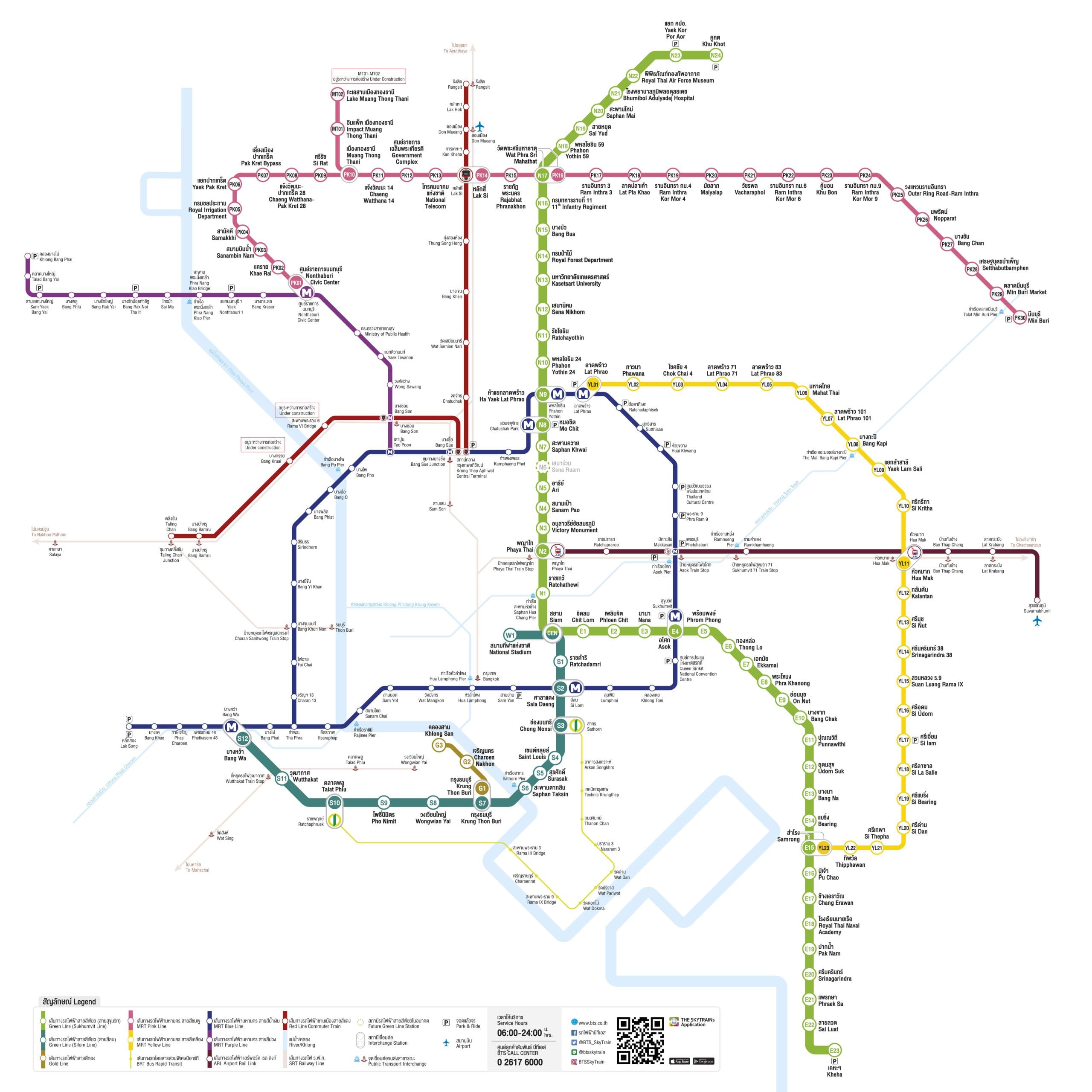
View the full Bangkok rail transit map
This map shows the Airport Rail Link, BTS Skytrain, MRT Blue, Purple, Pink and Yellow Lines, the SRT Red Line, the Gold Line and other rail connections.
Tip: save the full-size map to your phone before you land, so you can check routes and interchange stations even before your SIM or eSIM is working.
Airport Rail Link Route & Stations
The Airport Rail Link has eight stations on a single line with no branches, so it is easy to follow and hard to get wrong. Announcements are made in Thai, English and Chinese, and every station is coded A1 to A8 on signs and maps.
Here is what each station is useful for, with the fare from the airport.
Suvarnabhumi (A1)
The airport terminus is on Basement Level B, one floor below the taxi and bus level. It is the only air-conditioned station on the line, and you will usually find ATMs and currency exchange counters right by the entrance.
Boarding here works a little differently than on most metro systems. When a train arrives, everyone gets off first, then the doors close briefly while staff check and clean the carriages. Boarding starts when a staff member signals, often with a whistle.
Photo by Thailand Insider Guide.
Insider Tip
When you board at Suvarnabhumi, take a seat on the platform side of the train. Once the train climbs onto the elevated track, you get a wide view across Bangkok, and on clear days you can see the skyline before the line curves toward Lat Krabang. These seats also stay out of direct sun for most of the ride.
Lat Krabang (A2)
From the airport: THB 15
The first stop after the airport, mainly used by commuters and students from King Mongkut’s Institute of Technology Ladkrabang (KMITL). Useful if you are staying at an airport-area hotel or spending one night near the airport after a late arrival. The Paseo Mall and Robinson Lifestyle Lat Krabang are nearby, but a short taxi ride is easier than walking in the heat.
Ban Thap Chang (A3)
From the airport: THB 20
A small residential station with no visitor sights or hotel areas nearby. Most travellers simply ride through.
Hua Mak (A4)
From the airport: THB 25
The station for the MRT Yellow Line, which runs along the Srinakarin corridor toward Samrong and north to Lat Phrao. Useful if you are heading to Seacon Square, Thanya Park or accommodation in East Bangkok. The two stations are not directly connected, so read our Hua Mak transfer directions before you go.
Ramkhamhaeng (A5)
From the airport: THB 30
A busy, local area with markets, small restaurants and Ramkhamhaeng University nearby. Mainly useful if your accommodation, workplace or university is along Ramkhamhaeng Road.
Insider Tip
Ramkhamhaeng station is close to Khlong Saen Saep, where the canal boats run west toward Pratunam and the Golden Mount area. It is a cheap, traffic-free way into the old city, and a fun ride if you are travelling light.
Makkasan (A6)
From the airport: THB 35
The main transfer station for the MRT Blue Line, via a covered skywalk to Phetchaburi MRT station of about 7 to 10 minutes. Often the most direct route to Asok, Sukhumvit and Silom. See our Makkasan transfer directions.
Ratchaprarop (A7)
From the airport: THB 40
In the Pratunam area, close to Platinum Fashion Mall, wholesale markets and plenty of budget to mid-range hotels. There is no BTS or MRT connection here, but if your hotel is within walking distance, it saves you a transfer.
Phaya Thai (A8)
From the airport: THB 45
The city terminus and the most common transfer point, with a direct walkway to the BTS Skytrain for Siam, Sukhumvit and Silom. See our Phaya Thai transfer directions.
Travel Time & Operating Hours
The full journey between Suvarnabhumi and Phaya Thai takes about 26 to 30 minutes, and because the train never meets road traffic, that time barely changes through the day.
Trains run daily from around 5:30 am until midnight, roughly every 10 minutes at peak times (6:00 to 9:00 am and 4:00 to 8:00 pm) and every 15 minutes off-peak and at weekends. First and last departure times can shift slightly, so check them before a very early flight or a late-night arrival.
Weekday rush hours can get crowded, especially heading toward the airport in the evening. See our rush hour tips if you are travelling with large luggage.
Fares & Tickets
Fares are distance-based, from THB 15 for one stop to THB 45 for the full journey between Suvarnabhumi and Phaya Thai. Children under 90 cm travel free. Taller children pay the adult fare.
Paying with Contactless Cards (Tap to Pay)
Since November 2025, the easiest way to pay is to tap a contactless credit, debit or prepaid card at the entry gate. Most international cards work, including Visa, Mastercard, JCB and UnionPay. Look for the contactless logo on the gates marked for card payment. Tap again when you exit, and the correct fare is charged automatically.
At Suvarnabhumi and Phaya Thai, it works slightly differently. Instead of tapping at the gate itself, you tap your card on a separate reader in front of an open gate, wait for the green light, then walk through. Staff are usually nearby if you are unsure.
Insider Tip
Always tap in and out with the same physical card. If you tap in with a card in your phone wallet and out with the plastic card, the system sees two different cards and you may be charged an incomplete-trip fare.
It is also worth letting your bank know you are in Thailand, as some banks block the first contactless charge abroad.
Ticket Prices
Photo by Thailand Insider Guide.
Other Payment Options
If you prefer not to pay by card, there are two alternatives.
Single-Journey Tokens
Buy a token from the ticket machines (English menu available) or a staffed counter. Machines take coins and notes, but smaller notes work best, as large bills are not always accepted. Tap the token at the entry gate, then insert it into the exit gate at the end of your trip.
Stored-Value Card
The Airport Rail Link has its own rechargeable stored-value card. It is mainly used by commuters and residents, but it can save time at the machines if you use the line regularly.
Photo by Thailand Insider Guide.
Important: Tickets Do Not Carry Over to BTS or MRT
Airport Rail Link tokens and cards are not valid on the BTS or MRT, and Rabbit cards are not accepted on the Airport Rail Link. If you transfer, you pay separately on the next line. Payment options differ between systems, so check our BTS Skytrain and MRT guides for how to pay on each.
How to Transfer to BTS and MRT
Three Airport Rail Link stations connect to Bangkok’s wider rail network, so you can reach most of the city without entering road traffic. Remember that you pay separately on each line, as tickets do not carry over.
Transfer to BTS at Phaya Thai
At a glance: a few minutes’ walk, fully covered, easy with luggage.
Phaya Thai is the last stop and the most convenient transfer for most visitors. From the Airport Rail Link platform, take the escalators down one level and follow the signs across the elevated walkway to the BTS station.
From Phaya Thai BTS station, you can easily reach:
- Siam (central shopping district)
- Sukhumvit
- Silom, via an interchange at Siam
For fares and how to pay on the BTS, see our BTS Skytrain guide.
Transfer to MRT Blue Line at Makkasan
At a glance: 7 to 10 minutes on foot, mostly covered, manageable with luggage but quite warm during the day.
From the Airport Rail Link platform, follow the signs to the elevated walkway leading to Phetchaburi station on the MRT Blue Line.
At the end of the walkway, go down the escalators and past a few food shops and a restaurant. Turn right around the corner, then right again to reach the escalators down to the MRT entrance. After a brief security check, another set of escalators takes you down to the concourse, with the ticket office and machines on your right. Tap a contactless bank card at the gate, or buy a single-journey token.
This transfer is particularly useful for reaching:
- Asok and Sukhumvit (one stop to Sukhumvit MRT)
- Silom and Lumphini
- Hua Lamphong and Chinatown
- Bang Sue and other stops on the MRT Blue Line loop
Transfer to MRT Yellow Line at Hua Mak
At a glance: about 10 minutes, partly at street level along a busy road, best with light luggage.
The Airport Rail Link and MRT Yellow Line stations at Hua Mak are not directly connected. From the Airport Rail Link station, follow the signs to Exit 1 and go down to street level. This exit is signposted Srinagarindra Road, another spelling of Srinakarin Road. Walk in that direction, turn left and cross the railway. Take care here, as traffic on Srinakarin Road passes close and there is no proper sidewalk.
On your left, you will then see the entrance below, with stairs on the left and a lift on the right.
Go up to the elevated walkway by stairs, escalator or lift. From there, it is about five minutes to Hua Mak station on the MRT Yellow Line.
This transfer is useful for the Srinakarin corridor, Samrong, Lat Phrao, and places such as Seacon Square and Thanya Park. Most short-term visitors staying in central Bangkok will not need it.
Insider Tip
With large suitcases or in the midday heat, a two-minute taxi ride is more comfortable than walking this transfer. Ask the driver for the MRT Yellow Line Hua Mak entrance with the lifts and stairs (Entrance 2), just before McDonald’s. Show them this: กรุณาพาไป MRT สายสีเหลือง สถานีหัวหมาก ทางเข้า 2 ก่อนถึงแมคโดนัลด์
Which Transfer Should You Choose?
- Phaya Thai: best for BTS destinations, including Siam, Sukhumvit and Silom
- Makkasan: best for MRT Blue Line destinations, including Asok, Sukhumvit and Silom
- Hua Mak: best for East Bangkok and the MRT Yellow Line corridor
- Ratchaprarop: no transfer needed if your hotel is in Pratunam
Luggage & Comfort on the Airport Rail Link
The Airport Rail Link is modern and air-conditioned, but it is a commuter line rather than a dedicated airport train, and that affects space and comfort at busy times.
Luggage Space
There are no dedicated luggage racks, only open standing areas near the doors. Standard suitcases are usually fine, especially outside rush hour. With very large or multiple bags, stand by the doors or at the ends of the carriage, where there is more room.
Heat at Stations
Suvarnabhumi station is inside the airport and therSuvarnabhumi is the only air-conditioned station. The other seven are elevated and open to the heat, with ceiling fans on some platforms. If you just miss a train, the wait on a midday platform can feel long, so keep water handy. You will often see commuters with small handheld fans.
Accessibility
All stations have lifts, and boarding is near level, so the line works well with a wheelchair, stroller or heavy luggage. The main exception is the Hua Mak transfer to the MRT Yellow Line, which involves a walk along a busy road. Phaya Thai and Makkasan are the easiest transfer stations.
Rush Hour Considerations
On weekdays from roughly 7:00 to 9:00 am and 4:00 to 8:00 pm, trains fill with office workers.
Photo by Thailand Insider Guide.
The evening rush toward the airport is the hardest. At Makkasan in particular, trains can arrive already full, and you may need to wait for the second or even third train. With large bags, avoid the middle carriages, which fill first, and allow extra time.
Insider Tip
Heading to the airport in the evening rush? Start at Phaya Thai rather than Makkasan. Phaya Thai is the terminus, so trains leave there empty and you can board with your bags and usually get a seat. By the time they reach Makkasan, many are already full.
Airport Rail Link vs Taxi, Grab & Airport Bus
The right choice depends on your arrival time, luggage, group size and where you are staying.
| Option | Time to central Bangkok | Approximate cost | Best for |
| Airport Rail Link | 26 to 30 minutes. plus any transfer | THB 15 to 45 | Solo travellers, light luggage, rush hour |
| Taxi (metered) | 30–90 minutes, depending on traffic | THB 400–575, including the THB 50 airport surcharge and tolls | Heavy luggage, groups, door-to-door |
| Grab / LINE MAN | Similar to taxi | Taxi bookings: meter rate plus a THB 20 booking fee. Private cars: price shown upfront in the app | Booking in English, no need to explain your destination |
| Airport Bus | 45 to 90 minutes | THB 60 to 150 | Budget travellers on specific routes |
When the Airport Rail Link Is the Best Choice
- You arrive during peak traffic hours
- You are travelling alone or with one suitcase
- Your hotel is near a BTS or MRT station
- You want a predictable journey time
When a Taxi May Be Better
Outside rush hour, a taxi can be just as fast and takes you door to door. In short, road transport usually wins in the four situations below.
When Not to Use the Airport Rail Link
Late-Night Arrivals & Early Flights
Trains run from around 5:30 am until midnight, so the Airport Rail Link does not cover very late arrivals or very early departures.
If you land late in the evening, immigration and baggage claim can easily take an hour or more. Unless you are confident you will be on the platform well before midnight, a taxi, Grab or LINE MAN is the safer option.
For early flights, the first train from Phaya Thai only reaches the airport around 6:00 am. That is too late for most international departures before about 8:00 am, so book a taxi or ride instead.
Very Large or Multiple Suitcases
With several oversized bags, crowded trains and platform transfers become hard work. A door-to-door car is more comfortable.
Group Travel
For three or four people, the combined train and onward BTS or MRT fares start to approach the cost of one taxi, which also takes you straight to the door.
Hotels Far from Rail Lines
If your hotel is not within walking distance of a BTS or MRT station, you will need a taxi or Grab at the other end anyway. Going directly from the airport usually saves time.
Step-by-Step: How to Use the Airport Rail Link from Suvarnabhumi
Just landed? Here is how to get from the arrivals hall to the train.
1. Clear Immigration & Collect Your Luggage
After immigration and customs, you come out into the arrivals hall on Level 2.
2. Go Down to Basement Level B
Take the escalators or lifts all the way down to Level B (Basement). Do not stop at Level 1, which is for taxis and public buses. The train station is one floor further down.
3. Follow the Airport Rail Link Signs
Signs for the Airport Rail Link are placed throughout the terminal and lead you down to the station entrance on Level B. If you need cash, there are usually ATMs and exchange counters right outside.
Insider Tip
Many signs in the terminal still show two train icons: a blue City Line and a red Express Line. The non-stop Express Line to Phaya Thai no longer runs. Every train is now a City Line train that stops at all eight stations, so simply take the next train that arrives.
4. Pay Your Fare
The quickest option is a contactless credit or debit card: no ticket needed, just tap and go. Otherwise, buy a single-journey token for your destination from a ticket machine or the staffed counter. It costs THB 45 to Phaya Thai.
5. Enter Through the Gates
Tap your card on the contactless reader in front of the marked gate and wait for the green light, or tap your token on the gate reader.
6. Wait for the Next Train
Trains run every 10 to 15 minutes. When one arrives, all passengers get off first, and staff briefly check the carriages before boarding starts.
7. Exit at Your Destination
Tap the same card again at the exit gate, or insert your token into the slot. If you are transferring to the BTS or MRT, follow the signs and pay separately on the next line.
Insider Tip
Before you board, look up your hotel in Google Maps with public transport directions. It shows which station to get off at, whether you need to transfer, and the exit closest to your hotel, which saves a lot of wandering with luggage.
Going to the Airport
The trip works the same way in reverse. Board any train toward Suvarnabhumi, as every train terminates at the airport. From the station on Level B, take the lifts or escalators up to Departures on Level 4. On weekday evenings, allow extra time for crowded trains, and see our rush hour tips.
Frequently Asked Questions About the Airport Rail Link
Is the Airport Rail Link safe?
Yes. It is widely used by commuters and international travellers, stations are staffed, and there is a visible security presence. As on any busy transport, keep an eye on your bags during rush hour.
Does the Airport Rail Link run 24 hours?
No. Trains run from around 5:30 am until midnight. For late-night arrivals or flights before about 8:00 am, take a taxi, Grab or LINE MAN instead.
How long does the Airport Rail Link take?
About 26 to 30 minutes between Suvarnabhumi and Phaya Thai. Because the train never meets road traffic, the journey time stays the same all day.
How much does the Airport Rail Link cost?
THB 15 to 45 depending on distance. The full trip from Suvarnabhumi to Phaya Thai costs THB 45. Children under 90 cm travel free.
Can I pay with a credit card?
Yes. Since November 2025, you can tap a contactless Visa, Mastercard, JCB or UnionPay card at the marked gates. Tap in and out with the same card.
Can I use a Rabbit card on the Airport Rail Link?
No. Rabbit cards work on the BTS and the MRT Pink and Yellow Lines, but not on the Airport Rail Link. Pay with a contactless bank card, a single-journey token or the ARL stored-value card.
Is there still an express train?
No. The former non-stop Express Line no longer runs, even though some airport signs still show its red icon. All trains now stop at every station and take about 26 to 30 minutes to Phaya Thai.
Where is the Airport Rail Link at Suvarnabhumi Airport?
On Level B (Basement), below the arrivals hall on Level 2 and the taxi level on Level 1. Follow the Airport Rail Link signs down from arrivals.
Does the Airport Rail Link go to Don Mueang Airport?
No. It only serves Suvarnabhumi. Don Mueang is on the SRT Red Line, which you can reach from central Bangkok via Krung Thep Aphiwat Central Terminal. To travel between the two airports, see our guide to transferring between Suvarnabhumi and Don Mueang.
Is the Airport Rail Link good for large luggage?
It works well for standard suitcases, especially outside rush hour. There are no luggage racks, though, and trains get crowded at commuter times, so with several large bags a taxi is often easier.
Did this guide answer your question?
If something was missing or unclear, please tell us so we can improve this guide.
Glad it helped! Thank you for letting us know.
We’d love to know what was missing.
Planning Your Arrival in Bangkok
For most travellers, the Airport Rail Link offers the best balance of speed, cost and reliability, especially when traffic is heavy. Whether it is the right choice for you depends on your luggage, arrival time and where you are staying.
These guides help with the rest of your journey:
Suvarnabhumi Airport Guide: arrivals, departures, SIM cards and getting to the city
Getting Around Bangkok: how the BTS, MRT, taxis and boats fit together
BTS Skytrain Guide: routes, stations, fares and how to pay
Bangkok MRT Guide: lines, fares and key interchange stations
Enjoyed this guide?
If Thailand Insider Guide helped you plan your trip, you can support our independent work by buying us a coffee.


