

Bangkok is a vast, fast-moving city, and choosing the right way to get around can make a big difference to your experience. While the Bangkok city guide gives a quick snapshot of transport options, this guide focuses on the practical side of moving around Bangkok: what to use, when to use it, and what to avoid.
From elevated trains and underground metros to river boats, airport connections, taxis, and ride-hailing apps, Bangkok offers more transport choices than most visitors expect. Each option has its strengths, depending on time of day, distance, budget, and where you are staying.
In this guide, we break down:
- Which transport options are fastest, cheapest, or most convenient
- How BTS, MRT, airports, boats, and taxis connect
- Common mistakes first-time visitors make
- Insider tips to save time, avoid crowds, and reduce stress
Whether you’re visiting Bangkok for the first time or returning and want to move around more efficiently, this page helps you choose the right transport for every situation.
For detailed routes and station information, see our dedicated guides to the BTS Skytrain and MRT Metro.
Table of Contents
- How Transport in Bangkok Works
- Bangkok Rail Transit Map (BTS, MRT, Airport Rail Link & More)
- Which Transport Should You Use in Bangkok?
- BTS Skytrain: When and Why to Use It
- MRT Metro: How It Complements the BTS
- Airport Connections: Getting In and Out of Bangkok
- River Boats & Ferries: An Underrated Way to Get Around
- Taxis, Grab & Ride-Hailing: Flexible but Traffic-Dependent
- Buses & Other Local Transport: Cheap but Less Visitor-Friendly
- Practical Tips & Common Mistakes When Getting Around Bangkok
- How to Combine Transport for a Smooth Trip in Bangkok
- Explore Further
How Transport in Bangkok Works

Bangkok is a large, spread-out city, but getting around is generally more efficient than many first-time visitors expect. Instead of relying on one single transport system, Bangkok uses a mix of elevated trains, underground metro lines, river transport, and road-based options, each suited to different situations.
The key to moving around Bangkok smoothly is understanding which transport option works best for which journey. Skytrains and metro trains are often the fastest way to cross the city during busy hours, while boats can be surprisingly efficient along the river. Taxis and ride-hailing apps offer flexibility, but travel times can vary greatly depending on traffic.
Unlike some cities, Bangkok’s public transport is not built around a single central hub. The BTS Skytrain and MRT Metro complement each other, covering different parts of the city and connecting at several interchange stations. Airport connections, river boats, and local transport fill in the gaps.
Once you know the basics, getting around becomes straightforward. Most visitors quickly settle into a routine that combines two or three transport types, depending on where they are staying, the time of day, and how far they are travelling.
This guide helps you understand how Bangkok’s transport system fits together, so you can choose the right option for each trip, avoid unnecessary delays, and spend more time enjoying the city.
Bangkok Rail Transit Map (BTS, MRT, Airport Rail Link & More)
For an overview of all rail connections in Bangkok, including BTS, MRT, and the Airport Rail Link, see our Bangkok Rail Transit Map (BTS, MRT, Airport Rail Link & More).
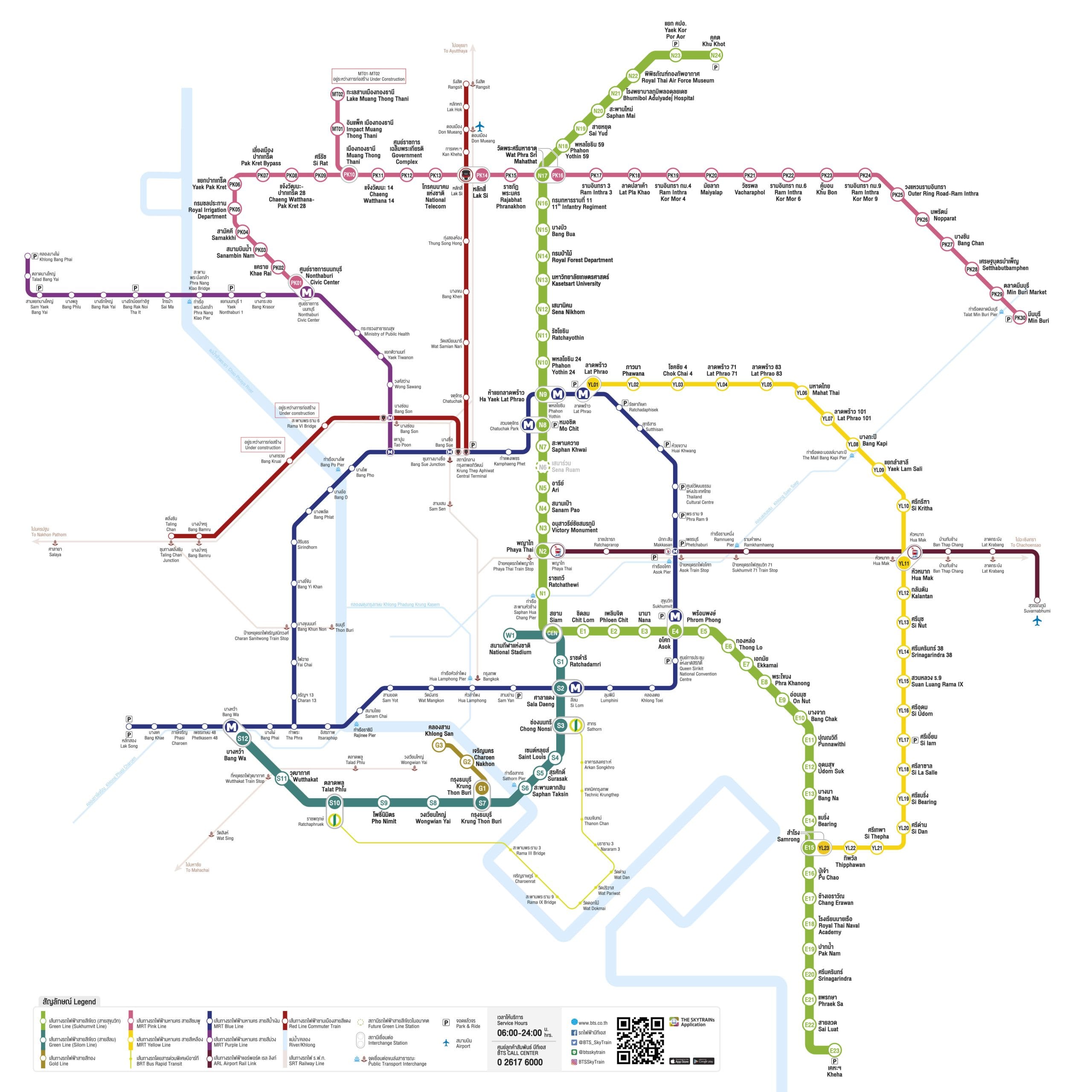
Click on the map to view the full image.
💡 Tip: Download the map to keep a copy on your phone while traveling.
Which Transport Should You Use in Bangkok?
Bangkok offers many ways to get around, but no single option is best for every trip. The right choice depends on time of day, distance, traffic conditions, and where you’re going. The overview below helps you decide quickly.
Quick Transport Comparison
| Situation | Best Option | Why |
| Crossing the city during rush hour | BTS or MRT | Fast, reliable, not affected by traffic |
| Short trips outside peak hours | Taxi or Grab | Convenient door-to-door travel |
| Arriving from Suvarnabhumi Airport | Airport Rail Link or taxi | Rail avoids traffic, taxi is easiest with luggage |
| Sightseeing along the river | Chao Phraya boats | Scenic, affordable, often faster than roads |
| Visiting markets or older districts | MRT + walking | Good access to Chinatown and Chatuchak |
| Late night travel | Taxi or Grab | Trains stop running around midnight |
| Tight schedule, short distance | Motorbike taxi | Fast but only for confident riders |
| Short, fun rides in tourist areas | Tuk-tuk | Memorable experience, not time- or cost-efficient |
Tuk-Tuks: What to Know
Tuk-tuks are one of Bangkok’s most recognisable sights and can be fun for short rides, especially in tourist areas. However, they are rarely the cheapest or fastest option, and fares must be negotiated in advance.
They make sense for:
- Very short distances
- Quick hops in low-traffic areas
- The experience itself
They are usually not ideal during rush hour or for longer trips, where trains or taxis are more reliable, and you may end up sitting in traffic and exhaust fumes.
💡 Insider Tip: If you want to try a tuk-tuk, agree on the price before getting in and treat it as part of the experience rather than a practical way to get across the city.
How Most Visitors Combine Transport
Most travellers use two or three transport types rather than relying on just one. A common combination looks like this:
- BTS or MRT for longer cross-city travel
- Walking or a short motorbike taxi (win motorsai) for the final stretch
- Taxi or Grab when trains are inconvenient or closed
This mix gives you speed, flexibility, and predictable travel times.
A Note on Traffic and Timing
Bangkok traffic can be heavy, especially:
- 7:00–9:00 am
- 5:00–7:00 pm
During these hours, trains are usually the fastest option, even if a taxi looks tempting on the map. Outside peak times, road transport becomes far more practical.
💡 Insider Tip: If Google Maps shows similar travel times for train and taxi during rush hour, the train is almost always the safer choice.
BTS Skytrain: When and Why to Use It
The BTS Skytrain is one of the fastest and most reliable ways to move around central Bangkok. Running above street level, it avoids traffic entirely and is especially useful during busy periods.
The BTS works best for:
- Crossing the city during rush hour
- Shopping and business districts
- Areas along Sukhumvit and Silom
- Travellers staying near major roads and malls
Because stations are clearly signed and well connected to malls and office areas, the BTS is often the easiest option for first-time visitors.
That said, the BTS does not cover every part of the city. Some historic areas, local neighbourhoods, and riverside locations are better reached by the MRT, boats, or a combination of transport options.
When the BTS Is the Best Choice
- Morning and evening rush hours
- Longer trips between popular districts
- Hot or rainy days, when walking and road traffic are less appealing
When Another Option May Be Better
- Visiting Chinatown, Old Town, or Chatuchak (often better via MRT)
- Short door-to-door trips outside peak hours
- Late-night travel, after trains stop running
💡 Insider Tip: If your hotel is within walking distance of a BTS station, using the Skytrain for most daytime trips will save time and reduce stress.
For routes, stations, tickets, and interchange details, see our full BTS Skytrain guide.
MRT Metro: How It Complements the BTS
The MRT Metro fills important gaps in Bangkok’s rail network and is especially useful for areas not served by the BTS. Running mostly underground, the MRT provides reliable access to local neighbourhoods, historic districts, and major markets.
Rather than competing with the BTS, the MRT is designed to work alongside it. Several interchange stations allow easy transfers between the two systems, making it possible to cross large parts of the city without relying on road transport.
The MRT works best for:
- Chinatown and Old Town access
- Chatuchak Weekend Market
- Northern and eastern districts
- Avoiding surface traffic in busy areas
Stations are modern and well signposted in English. On the MRT Blue Line, most stations have air-conditioned platforms, making the MRT just as easy to use as the BTS for most visitors.
When the MRT Is the Better Choice
- Visiting Chinatown (Yaowarat) or historic areas
- Going to Chatuchak Market
- Staying outside central Sukhumvit or Silom
- Combining train travel with walking in older districts
When the BTS May Be More Convenient
- Shopping malls and office districts
- Hotels located along Sukhumvit or Silom
- Direct station access connected to malls
💡 Insider Tip: If your destination is closer to an MRT station than a BTS station, the MRT is usually the more efficient option, even if the BTS looks more familiar.
For line maps, stations, tickets, and interchange details, see our full MRT Metro guide.
Airport Connections: Getting In and Out of Bangkok
Bangkok has two main airports serving different types of flights, and choosing the right transport on arrival can save significant time and stress.
Suvarnabhumi Airport (BKK)
Suvarnabhumi handles most international long-haul flights and many regional connections. From here, travellers mainly choose between the Airport Rail Link and taxis or ride-hailing, depending on timing, luggage, and destination.
Airport Rail Link (Fast and Predictable)
The Airport Rail Link (ARL) is the most reliable way to reach the city during busy periods.
- Follow signs for Airport Rail Link inside the terminal
- Trains depart from the basement level
- Direct service to Phaya Thai, with stops along the way
- Easy transfers to BTS and MRT at connected stations
This option avoids traffic entirely and is often the fastest choice during peak hours.
Best suited for: Rush hour arrivals, lighter luggage, and destinations near rail lines.
Taxis from Suvarnabhumi Airport
Taxis are convenient for door-to-door travel, especially with luggage.
- Follow signs for Public Taxi
- Go to the official taxi queue area
- Take a ticket with a queue number and assigned taxi
Fares are metered, plus:
- Airport surcharge (THB 50)
- Expressway tolls (if used)
- In some cases, a small luggage fee
The system is organised and avoids negotiation, though waits can be longer during peak arrival times.
💡 Insider Tip: You can tell the driver whether or not you want to use toll roads. Tolls are paid separately.
Ride-Hailing
Apps like Grab operate at Suvarnabhumi, but pick-up points can vary and prices may surge during busy periods. They’re useful if you prefer cashless payment or a quoted fare.
Choosing the Best Option from Suvarnabhumi
- Rush hour arrivals: Airport Rail Link
- Late night or early morning: Taxi or ride-hailing
- Heavy luggage or family travel: Taxi
- Staying near BTS/MRT: Airport Rail Link + short transfer
💡 Insider Tip: If you arrive during weekday rush hours, the Airport Rail Link is often significantly faster than a taxi, even if road traffic initially looks manageable.
Don Mueang International Airport (DMK)
Don Mueang mainly serves domestic routes and low-cost airlines. While taxis and ride-hailing remain common, the airport is now well connected by rail, making it easier to avoid traffic during busy periods.
Train: SRT Red Line (Fast and Predictable)
Don Mueang is connected to Bangkok’s rail network via the SRT Red Line, which is often the most reliable option during weekday rush hours.
- The train station is directly connected to the airport
- Trains run to Bang Sue Grand Station
- From Bang Sue, you can transfer to:
- MRT Blue Line
- Other suburban and long-distance trains
- Taxis or ride-hailing for the final leg
If you arrive at the International Terminal, allow about 10 minutes of walking to reach the Domestic Terminal, then follow signs to the SRT Red Line.
Train operating hours
The SRT Red Line runs from 5:00 AM to midnight, typically every 10–15 minutes.
Tickets and Payment
- Buy tickets at the Commuter Line ticket office or vending machines
- You can also skip the queue by tapping to pay with a Visa or Mastercard credit card
Best suited for: Rush-hour arrivals, lighter luggage, and destinations near rail lines.
💡 Insider Tip: Cheap Local Food Before You Board
On the way to the SRT Red Line station, you’ll pass Magic Food Park, one of the cheapest places to eat at the airport.
It’s popular with airport staff and offers simple Thai dishes at local prices. If you have time before boarding the train, this is an easy way to grab a decent meal without paying typical airport prices.
Taxis and Ride-Hailing (Flexible, but Traffic-Dependent)
Taxis are widely available at Don Mueang, but the process is more structured than simply flagging one down.
- Follow signs to the official taxi queue
- Take a queue number from the machine
- A small airport surcharge applies
- Additional fees may apply for tollways and large luggage
- During peak times, queues can be long but usually move steadily.
During peak traffic hours, road travel times can increase significantly. Late at night or early in the morning, however, taxis are often the most convenient option.
Ride-hailing apps like Grab are also available, though pickup points may be less intuitive during busy periods.
Choosing the Best Option at Don Meuang
- Rush hour (weekday mornings & evenings): SRT Red Line
- Late night or early morning flights: Taxi or ride-hailing
- Heavy luggage: Taxi for door-to-door convenience
- Budget-focused travel: SRT Red Line combined with MRT or taxi
💡 Insider Tip: If you land during weekday rush hours, the SRT Red Line is usually faster and more predictable than road transport, even if traffic looks manageable at first.
River Boats & Ferries: An Underrated Way to Get Around
Bangkok’s rivers and canals are not just scenic, they are also practical transport routes that can save time and offer a very different view of the city. For certain journeys, boats are faster and more relaxing than travelling by road.
The most useful service for visitors is the Chao Phraya Express Boat, which runs along the Chao Phraya River and connects several major sights and neighbourhoods.
River transport works best for:
- Temple hopping along the Chao Phraya River
- Avoiding road traffic in central areas
- Sightseeing combined with transport
- Reaching riverside hotels and attractions
Piers are generally well marked, and boats run frequently during the day. Tickets are inexpensive, and the experience itself is often a highlight for visitors.
Canal Boats (Khlong Boats)
Bangkok also has a limited network of canal boats that locals use to bypass traffic. These can be very fast, but they are less intuitive for first-time visitors and require some confidence, especially during busy hours.
For most travellers, canal boats are best used once you are familiar with the city, or when following a specific route recommendation.
When Boats Make Sense
- Visiting riverside temples and landmarks
- Travelling during heavy road congestion
- Looking for a scenic alternative to trains and taxis
When Another Option Is Better
- Late at night (limited services)
- Travelling far from the river
- Carrying large luggage
💡 Insider Tip: Boats are one of the few ways to experience Bangkok without sitting in traffic. Even if they’re not the fastest option for your route, they’re often the most enjoyable.
Taxis, Grab & Ride-Hailing: Flexible but Traffic-Dependent
Taxis and ride-hailing are widely used in Bangkok and offer the most flexible, door-to-door way to get around. They are easy to find, relatively affordable, and often the simplest option outside peak hours.
Metered Taxis
Metered taxis are everywhere in Bangkok. When traffic is light, they can be comfortable and cost-effective. During busy periods, however, journey times can increase significantly.
Good for:
- Short to medium trips outside rush hour
- Late-night travel when trains are closed
- Travelling with luggage
Ride-Hailing Apps
Ride-hailing apps provide convenience, fixed pricing, and in-app navigation.
Common options include:
- Grab – the most widely used and reliable
- LINE MAN – very popular with locals; best known for food delivery, with ride-hailing available but not as visitor-friendly as other options
- Bolt – sometimes cheaper, availability varies
These apps are especially useful if you want:
- Clear pricing upfront
- Cashless payment
- Less language friction
Motorbike Taxis
Motorbike taxis are a common sight, particularly near train stations and busy streets. They can be extremely fast over short distances but are best suited to confident travellers.
Best for:
- Very short trips
- Getting out of traffic bottlenecks
Not ideal if you’re uncomfortable on a motorbike or carrying luggage.
When Road Transport Works Best
- Outside morning and evening rush hours
- For door-to-door convenience
- Late at night
When Trains Are the Better Choice
- 7:00–9:00 am and 5:00–7:00 pm
- Cross-city travel
- Predictable arrival times
💡 Insider Tip: If traffic looks heavy on Google Maps, trains are usually faster, even if the taxi fare seems reasonable.
Buses & Other Local Transport: Cheap but Less Visitor-Friendly
Bangkok has an extensive public bus network that reaches almost every part of the city. Buses are very affordable and widely used by locals, but they are usually not the easiest option for visitors.
Routes can be difficult to understand, stops are not always clearly marked, and journey times depend heavily on traffic. For short stays or tight schedules, trains, boats, or taxis are generally more practical.
When Buses Can Make Sense
- You’re travelling on a very tight budget
- You’re staying in Bangkok longer and have time to learn routes
- Your destination is not easily reached by BTS or MRT
When to Avoid Buses
- Short visits with limited time
- Peak traffic hours
- If you’re unfamiliar with the city layout
Other Local Transport
In some neighbourhoods, you may encounter shared local vehicles such as songthaews. These are area-specific and mostly used by locals. They can be useful in certain districts but are not something most visitors rely on in central Bangkok.
💡 Insider Tip: If you’re unsure whether a bus route is the right choice, trains or taxis are usually the safer and simpler option.
Practical Tips & Common Mistakes When Getting Around Bangkok
Bangkok’s transport system is easy to use once you understand it, but many frustrations come from a few common misunderstandings. Keeping the points below in mind will save time, money, and energy.
Don’t Underestimate Rush Hour
A common mistake is assuming traffic will be manageable during peak hours.
Traffic and trains are busiest:
- 7:00–9:00 am
- 5:00–7:00 pm
During these hours, trains are almost always faster than road transport, even for relatively short distances. If you must travel by road, allow extra time.
Rain Changes Everything
Many visitors underestimate how much rain affects traffic in Bangkok.
Bangkok traffic can slow down dramatically when it rains. Even a short downpour often leads to congestion, reduced visibility, and longer travel times.
When it’s raining:
- Road journeys usually take much longer than predicted
- Taxis can be harder to find
- Trains and stations may be busier than usual
If rain coincides with peak hours, BTS and MRT are usually the most reliable options, even for trips you might normally take by taxi.
💡 Insider Tip: If rain is forecast for the afternoon, plan longer journeys earlier in the day or stay close to train lines.
Trains Beat Taxis More Often Than You Think
A common misconception is that taxis are always the fastest option.
It’s tempting to choose a taxi for convenience, but during busy periods a train plus a short walk is often quicker and more predictable. Many experienced visitors default to BTS or MRT first, then use taxis only when trains are impractical.
Expect to Combine Transport
Some travellers new to Thailand expect door-to-door transport for every trip.
Very few journeys in Bangkok are perfectly door-to-door. A typical trip often looks like:
- Train for the main distance
- Walking for the final stretch
- Taxi or motorbike for short gaps
This is normal and usually more efficient than relying on one transport type.
Cash vs Cashless
Relying entirely on cashless payments can cause small but avoidable delays.
While cards and apps are increasingly accepted, it’s still useful to carry small amounts of cash, especially for taxis, motorbike taxis, boats, and local transport (songthaew / buses). Ride-hailing apps offer the most seamless cashless experience.
Metered Taxis in Tourist Areas
Some visitors assume all taxis will automatically use the meter.
Most taxis in Bangkok use the meter without issue, but in busy tourist areas and at certain times, some drivers may refuse to turn it on and instead quote a fixed price.
This is more likely:
- Near major attractions and nightlife areas
- Late at night
- During heavy rain
- When traffic is very congested
If a driver refuses to use the meter, you can simply decline and try another taxi. Ride-hailing apps are often a good alternative when this happens.
💡 Insider Tip: If a taxi won’t use the meter and the price feels high, politely move on. Another taxi is usually not far away.
Late-Night Transport
A common oversight is forgetting that trains stop running around midnight.
Most trains stop running around midnight. After that, taxis and ride-hailing are the main options. Availability is generally good, but allow extra time late at night on weekends.
Google Maps Is Helpful, Not Perfect
Google Maps works well in Bangkok, but it doesn’t always account for:
- Sudden traffic build-ups
- Weather-related delays
- Walking distances inside large stations
Use it as a guide, but apply common sense, especially during rush hour or heavy rain.
How to Combine Transport for a Smooth Trip in Bangkok
Getting around Bangkok efficiently is less about choosing one perfect transport option and more about combining the right options at the right time. Once you stop thinking in single journeys and start thinking in short segments, the city becomes much easier to navigate.
A Simple Rule That Works
- Use trains for distance
- Walk for the last stretch
- Use taxis or ride-hailing when trains don’t make sense
This approach avoids traffic where possible while keeping trips flexible.
Common Transport Combinations That Work Well
Airport to Hotel
- Airport Rail Link or taxi
- Short walk or taxi to your hotel if needed
Hotel to Shopping or Business Areas
- BTS Skytrain
- Walk directly into malls or office complexes connected to stations
Sightseeing Days
- MRT for Old Town or markets
- River boats for temples along the Chao Phraya
- Walking between nearby sights
Evening or Late-Night Travel
- BTS or MRT early in the evening
- Taxi or ride-hailing after trains stop running
Plan Around Time, Not Just Distance
Two places that look close on the map can take very different amounts of time depending on:
- Traffic conditions
- Time of day
- Weather
Before leaving, quickly check:
- Whether a train line covers most of the route
- Whether rain or rush hour might affect road travel
A small adjustment can save a lot of time.
Start Simple, Then Adjust
If you’re new to Bangkok:
- Start with BTS and MRT
- Add taxis when needed
- Try boats once you’re comfortable
Most visitors find their own rhythm within a day or two.
Explore Further
This page gives you the overall picture of getting around Bangkok. For practical details and planning help, these guides go deeper:
- BTS Skytrain – routes, stations, tickets, and interchange tips
- MRT Metro – lines, key areas, transfers, and travel advice
- Bangkok Travel Guide – neighbourhoods, highlights, and how everything fits together
- Best Apps to Use in Thailand – transport, maps, payments, and everyday essentials
Together, these pages help you plan efficiently, move around with confidence, and avoid common transport frustrations.


